Will Your High-Mileage Car Pass the Georgia Emissions Test? An Honest Guide for Buford Drivers
Each year, thousands of Gwinnett County drivers face a moment that feels a lot like waiting to see their report card.
You get your registration renewal notice. The odometer says 162,000 miles, maybe 187,000, or even 211,000. For the next two weeks, until you pull into the testing station, the same question lingers in your mind.
Is this the year it finally fails?
You have been driving this car for years. It runs. It gets you where you are going. You have kept up with the oil changes, the brakes, and the tires. But the mileage keeps climbing, and every year the emissions test feels a little more like a gamble than a formality.
Here is the honest answer: high mileage does not automatically mean a failed emissions test in Georgia. But it does mean specific components are more likely to be reaching the end of their effective life — and knowing which ones to pay attention to before your test can be the difference between walking out with a passing certificate and walking out with a repair bill.
This guide is written for drivers in Buford, Sugar Hill, Suwanee, and across Gwinnett County who are operating high-mileage vehicles and seeking a straightforward, practical answer to the question they are actually asking. Not a general overview of emissions testing. Not a list of tips recycled from every other article on the internet. The real answer is based on what we see every day at Emission First LLC at 3833 Buford Dr in Buford, GA.
What “High Mileage” Actually Means for Emissions Testing
Before proceeding, let us define what we are discussing.
In the context of Georgia emissions testing, high mileage means different things depending on the vehicle. A 2008 Toyota Camry with 180,000 miles on a long and consistent maintenance history is a fundamentally different emissions test situation than a 2014 Chevrolet Malibu with 180,000 miles on intermittent oil changes and deferred maintenance.
Mileage alone is not the whole story. What matters is what those miles have done to your vehicle’s emissions-related components, specifically the catalytic converter, the oxygen sensors, the evaporative fuel system, and the engine’s ability to run a clean and complete combustion cycle.
For the purposes of this guide, we are going to focus on the mileage ranges where emissions-related component wear becomes meaningfully more common:
- 100,000 to 130,000 miles. The early warning zone. Most factory-installed emissions components are still functional, but some are showing initial wear. Pass rates remain high with proper maintenance.
- 130,000 to 170,000 miles. The middle zone. This is where catalytic converter efficiency starts to become a real variable and where oxygen sensors begin to show meaningful degradation. More failures happen here than anywhere else.
- 170,000 miles and above. The high-attention zone. Most original emissions components in this range are well past their factory design life. Passing is absolutely still possible; many high-mileage vehicles pass cleanly, but the pre-test checklist becomes genuinely important.
None of these ranges means automatic failure. They mean that knowing what to check before your visit to the testing station becomes increasingly valuable the higher your mileage climbs.
The Components That Matter Most on a High-Mileage Vehicle
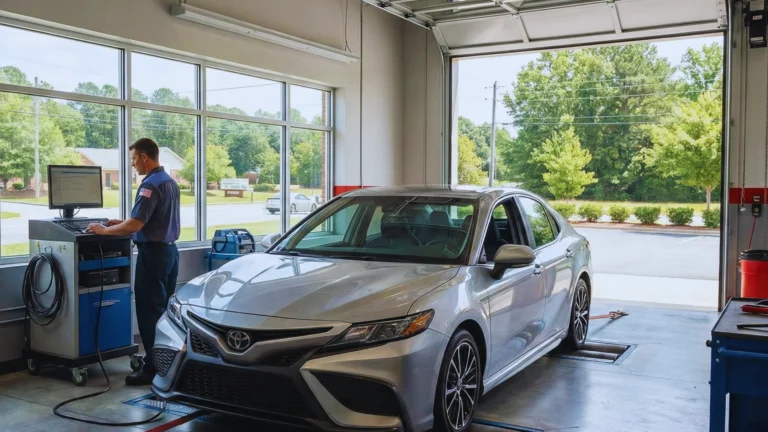
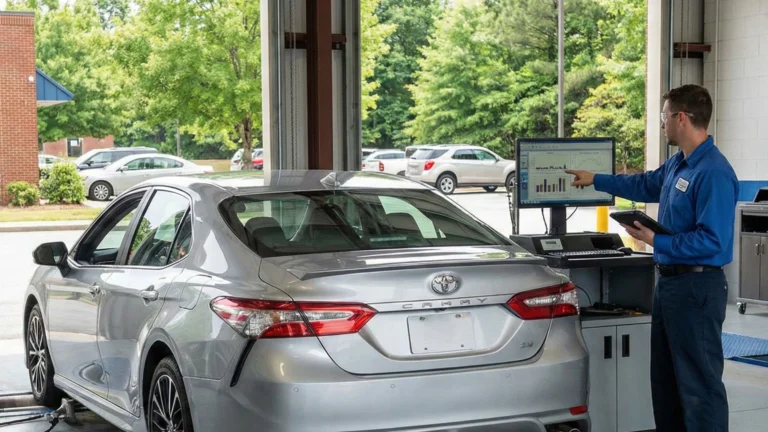
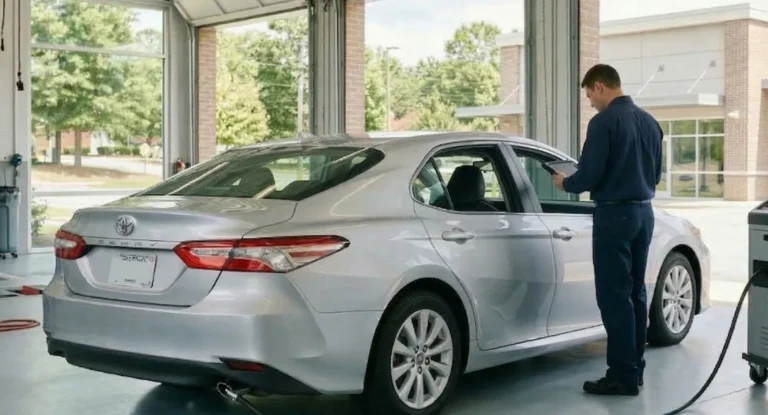
Georgia’s emissions test is an OBD-II diagnostic scan combined with a fuel cap seal test and a visual inspection of the catalytic converter. The test checks your vehicle’s emissions control system performance history and evaluates whether all emissions-related monitors have completed their diagnostic cycles. The components most likely to cause failures on high-mileage vehicles are the ones the test is specifically designed to evaluate.
Here is an honest breakdown of each one, what failure looks like at high mileage, and what you can do about it.
The Catalytic Converter: The Biggest Variable at High Mileage
The catalytic converter is the emissions system component most likely to cause a failure on a high-mileage vehicle, and it is also the most expensive to replace when it does.
The converter works by using precious metals, platinum, palladium, and rhodium as catalysts for a chemical reaction that converts toxic exhaust gases into less harmful ones. Over time and mileage, those catalytic materials degrade. The converter does not fail all at once; it loses efficiency gradually. At some point, it crosses a threshold where the OBD system detects that it is not converting at the required efficiency level, stores a P0420 or P0430 code, and lights the check engine light.
At 100,000 miles, a well-maintained catalytic converter is typically still performing well above the threshold. At 150,000 miles, many are still fine, but some are beginning to show meaningful degradation. At 180,000 miles and above, converter efficiency is one of the first things worth having a mechanic look at before your annual test.
The practical check: if your check engine light is on and the code is P0420 or P0430, you already know the converter is the issue. If the light is off but you have high mileage, it is worth asking your mechanic to evaluate converter performance during your next routine service rather than waiting to find out on test day.
Replacement cost ranges from $400 to $1,200 or more, depending on your vehicle. A quality direct-fit aftermarket converter from a reputable brand is typically sufficient for most standard gasoline vehicles. For hybrid vehicles at high mileage, OEM is the safer choice to avoid follow-up OBD efficiency code failures.
Oxygen Sensors: The Quiet Failure
Oxygen sensors monitor combustion efficiency by measuring the oxygen content in your exhaust gases. They feed real-time data to the engine computer, which uses it to continuously adjust the fuel mixture for optimal combustion and emissions performance.
Oxygen sensors have a finite lifespan. Most factory sensors are rated for approximately 60,000 to 100,000 miles, though many last significantly longer. At high mileage, particularly above 120,000 miles, sensor degradation becomes increasingly common. A degrading oxygen sensor does not always trigger the check engine light immediately. It can produce borderline readings that cause the engine to run slightly inefficiently without the OBD system logging an active fault code.
What it does do is reduce your vehicle’s ability to self-correct, which means emissions output edges upward even when nothing is obviously wrong. On a vehicle already at high mileage, marginal oxygen sensor performance can be the difference between a clean pass and a borderline fail.
The practical check: if your vehicle has never had oxygen sensors replaced and is approaching 120,000 miles or beyond, having them inspected and potentially replaced during a routine service visit is a reasonable maintenance step both for emissions test performance and for fuel economy.
Replacement cost is typically $150 to $350 per sensor installed, depending on the vehicle and which sensor is affected.
The Evaporative System and the Gas Cap Still Relevant at Any Mileage
The evaporative emissions control system prevents fuel vapors from escaping into the atmosphere. It seals the fuel system and routes vapors back into the engine for combustion. The gas cap is the simplest component of this system and also the most overlooked at every mileage level.
On a high-mileage vehicle, the gas cap’s rubber seal ages and cracks. The charcoal canister that stores fuel vapors can develop internal issues. Hoses and purge valves can crack or stick. Any of these failures triggers the evaporative monitor and often the check engine light.
Before every emissions test, regardless of mileage, the gas cap check takes thirty seconds and costs nothing. Remove it, look at the rubber seal, and reinstall it firmly until it clicks. If the seal looks cracked or dried out, a replacement cap costs $10 to $20 at any auto parts store and solves what would otherwise be a failed test.
Spark Plugs and Ignition System: The Combustion Quality Problem
This one surprises some drivers because spark plugs feel like basic maintenance rather than an emissions concern. But on a high-mileage vehicle with worn spark plugs, the connection is direct.
Worn spark plugs cause incomplete combustion. Incomplete combustion means unburned hydrocarbons end up in the exhaust. Unburned hydrocarbons are exactly what the Georgia emissions test is designed to detect and penalize. A vehicle with significantly worn plugs produces measurably higher hydrocarbon emissions than the same vehicle with fresh plugs.
If your vehicle is past 80,000 to 100,000 miles and has never had spark plugs replaced, or if you cannot remember the last time they were done, this is worth addressing before your emissions test. It is one of the most affordable tune-up items, and the improvement in combustion quality and fuel economy that comes with fresh plugs is real and measurable.
The Engine’s General Combustion Health
At very high mileage, 180,000 to 200,000 miles and above, the engine itself becomes a variable. Worn piston rings allow oil to enter the combustion chamber, which burns along with the fuel and produces blue or grey smoke. Degraded valve seals cause similar issues. Both result in elevated hydrocarbon and carbon monoxide readings that affect the OBD efficiency calculations.
This is the scenario where “the car runs fine” can coexist with “the emissions readings are off.” If your high-mileage vehicle has been burning oil needing a top-up between oil changes or producing visible exhaust smoke at any color other than faint white steam on a cold morning, it is worth having a mechanic evaluate compression and combustion health before your test.
This does not necessarily mean the vehicle cannot pass. Many high-mileage vehicles with minor oil consumption pass the Georgia emissions test without issue. But knowing where your vehicle stands gives you the ability to manage the situation rather than be surprised by it.
What High-Mileage Vehicles Actually Pass The Realistic Picture
Here is something that gets lost in the anxiety around high-mileage emissions testing: most high-mileage vehicles that come into Emission First LLC pass on the first visit.
That might sound surprising, but it reflects a simple truth about Georgia’s OBD-II emissions test. The test evaluates whether your emissions control systems are functioning correctly within acceptable limits, not whether your vehicle is new. A 2006 Honda Accord with 195,000 miles and a properly functioning catalytic converter, fresh oxygen sensors, and no active codes will pass just as cleanly as a 2018 model with 40,000 miles.
What the test cannot do is ignore a real problem. If the catalytic converter has genuinely degraded past the threshold, the OBD system knows it, and the test catches it. If an oxygen sensor has failed to the point of affecting fuel trim significantly, the test will find it. High mileage raises the probability of these issues, but it does not make passing impossible.
The drivers who come in with high-mileage vehicles and fail are almost always in one of three situations: they have an active check engine light they ignored, their vehicle had maintenance deferred for too long, or they came in immediately after a battery replacement or code clearing before their readiness monitors had time to complete.
The drivers who come in with high-mileage vehicles and pass consistently are the ones who stay on top of basic maintenance, oil changes, spark plugs, cooling system, and pay attention to what their dashboard is telling them in the weeks before their test.
The Pre-Test Checklist for High-Mileage Vehicles in Gwinnett County
If your vehicle is in the higher mileage ranges, here is a practical checklist to work through in the days before your visit to Emission First LLC. None of this is complicated. Most of it takes minutes.
Check your dashboard carefully — not just a glance.
Sit in your car for a moment and look at every indicator light. The check engine light is the obvious one; if it is on, you will fail automatically and should not come in yet. But also look for any other warning lights that might indicate issues affecting your emissions systems. Service engine soon, engine temperature, oil pressure — any of these warrant attention before your test.
Think about your battery and repair history in the last two weeks.
Has anything been reset, replaced, or reprogrammed on your vehicle recently? A battery replacement, a repair involving code clearing, or any electrical work can reset your OBD readiness monitors to incomplete. High-mileage vehicles sometimes need more frequent battery replacements than newer cars. If yours was done in the last ten days, wait another week before coming in. The monitors need one to two weeks of normal mixed driving to reset fully.
Check your gas cap tonight.
This takes thirty seconds and applies at any mileage. Remove the cap, look at the rubber seal, reinstall until you feel and hear it click. On a high-mileage vehicle, the cap’s seal may have been quietly deteriorating for years. A cracked seal is a $12 fix that prevents a failed evaporative monitor.
Look underneath for exhaust smoke.
On a warm engine at idle, look at your exhaust. No smoke or faint white steam on a cool morning, fine. Blue or grey smoke indicating oil burning worth investigating before your test. Black smoke, indicating a rich fuel mixture also worth looking at. These are not automatic disqualifiers, but they are signals worth understanding before test day.
Check for oil consumption between services.
If you are regularly topping off your oil between changes, your vehicle is consuming oil through combustion. This raises your hydrocarbon emissions output and can affect your test results on a vehicle already at high mileage. If consumption is significant, a mechanic conversation before your test is worthwhile.
Fuel up at a name-brand station a few days before your test.
Quality fuel with proper detergent additives helps keep your fuel system and combustion chamber cleaner. For a high-mileage vehicle, this is a small edge that costs nothing extra. Fill up at a Shell, BP, Chevron, or Exxon three to four days before your test and drive normally.
Drive normally in the days before testing, including some highway.
Do not let your car sit all week and then drive it cold to the testing station. Highway driving at sustained speeds in the days before your test helps the catalytic converter reach and maintain optimal operating temperature, which is exactly the condition the catalyst monitor needs to report clean and complete.
When Is It Worth Getting a Pre-Test Inspection for a High-Mileage Vehicle?
Most drivers do not need a mechanic visit before their annual emissions test. But there are specific situations where paying for a pre-test inspection is genuinely worth the cost, particularly at high mileage.
Your check engine light was recently on, but went off on its own. A light that appeared and disappeared without any repair done means a code was stored and then cleared — either by the vehicle’s own monitoring cycle, determining it was intermittent, or because someone disconnected the battery. In either case, the underlying issue that triggered the code is still potentially there. On a high-mileage vehicle, a previously stored code that has cleared itself warrants a diagnostic scan before the emissions test.
Your vehicle has gone more than 100,000 miles since the catalytic converter was last replaced. Factory catalytic converters are generally designed to last 100,000 miles under normal conditions. On a high-mileage vehicle that has never had converter work done, knowing where converter efficiency currently stands before test day is valuable information.
Your vehicle has been running noticeably differently in recent months. Rougher idle, slightly worse fuel economy, any exhaust smell, or new sounds from under the vehicle, all of these are worth investigating before the emissions test rather than after.
You have been deferring maintenance due to cost. High-mileage vehicles that have gone significantly longer than recommended between oil changes, with worn spark plugs, or with other deferred maintenance items, are at higher risk of emissions failures. Catching these things first on your terms gives you control over the situation.
A pre-test diagnostic scan at any auto parts store is free and takes five minutes. It will show any stored codes active or pending, and the readiness monitor status of each system. If everything comes back clean and all monitors show ready, you can walk into Emission First LLC with confidence. If something shows up, you know about it before it costs you a test fee and a second trip.
What If Your High-Mileage Vehicle Fails the Emissions Test?
It happens. And when it does, the process is the same as for any other vehicle, just potentially involving higher repair costs on a higher-mileage car.
When your vehicle fails at Emission First LLC, you receive a Vehicle Inspection Report explaining exactly what caused the failure. This is your starting point. Take it to a licensed mechanic, get a diagnostic analysis done, understand the specific repair needed, and make an informed decision.
For high-mileage vehicles, the most important additional consideration is the economics of the repair. If a catalytic converter replacement on a 195,000-mile vehicle costs $900, and the vehicle has another 50,000 miles of reliable life left, that repair cost is reasonable relative to the value you are getting. If the same repair is estimated at $900 on a vehicle that needs significant additional work to stay roadworthy, the calculation changes.
The repair waiver is worth understanding clearly at this mileage level. If your high-mileage vehicle requires significant repairs to pass and those costs reach $1,176 for 2026, you may qualify for a one-year waiver allowing registration renewal without passing. Document every repair dollar meticulously, including diagnostic fees, parts, and labor, all on itemized receipts from licensed shops.
The Honest Bottom Line for High-Mileage Drivers in Buford
Here is what we actually see at Emission First LLC, stated plainly.
The majority of high-mileage vehicles that come through our bay on Buford Drive pass their Georgia emissions test. Not all of them, but most. The ones that pass consistently have drivers behind them who pay attention to their vehicle’s signals, stay reasonably current on maintenance, and do not ignore warning lights or unusual symptoms until test day forces the issue.
The ones that fail are usually not surprises — at least they should not be. A P0420 catalytic converter code that has been clearing and coming back for six months eventually stays on. An oxygen sensor that has been running at the edge of its calibration window eventually crosses it. A gas cap seal that has been cracking for two years eventually fails the evaporative test. None of these are ambushes. They are processes that your vehicle was trying to communicate along the way.
The preparation checklist above is not complicated. It is just paying attention to what your car is already telling you, before test day forces you to deal with it under deadline pressure.
Come in when you are ready. Walk in any time Monday through Saturday at 3833 Buford Dr, Buford, GA 30519. No appointment, no scheduling, no waiting for a slot. The scan takes 5 to 10 minutes. We will tell you exactly what we find — clearly, honestly, and without any pressure to do anything beyond the test itself.
Frequently Asked Questions: High-Mileage Vehicles and Georgia Emissions Testing
Will my high-mileage car pass the Georgia emissions test? Mileage alone does not determine the outcome. A high-mileage vehicle with properly functioning emissions components, catalytic converter, oxygen sensors, and evaporative system can pass just as cleanly as a lower-mileage one. What high mileage does is increase the probability that specific components are reaching the end of their effective life. The preparation checklist above addresses the most important things to check.
What is the most common reason high-mileage cars fail emissions tests in Georgia? Catalytic converter degradation, specifically a P0420 or P0430 OBD code, is the most common failure cause among high-mileage vehicles. Oxygen sensor failures and incomplete readiness monitors following recent maintenance are also common.
Does Georgia emissions testing check physical condition or just computer data? Georgia’s OBD-II emissions test reads diagnostic data from your vehicle’s onboard computer, evaluates readiness monitor status, checks the fuel cap seal, and performs a visual inspection of the catalytic converter, confirming it has not been removed or tampered with.
My car has 200,000 miles and has always passed. Should I be worried this year? Not necessarily. Consistent past performance is a meaningful positive indicator. The best thing to do is run through the pre-test checklist dashboard check, gas cap, battery history, exhaust observation, and come in having confirmed your check engine light is off and your readiness monitors have had time to complete.
If my high-mileage car fails, is it worth repairing, or should I get a new car? That is a financial decision that depends on the repair cost, the overall condition of the vehicle, and how much useful life remains. The Vehicle Inspection Report from Emission First LLC gives you the specific failure cause, gets a repair estimate, compares it to the vehicle’s realistic remaining value, and makes an informed decision. The repair waiver is also available if costs reach the 2026 threshold of $1,176.
How much does an emissions test cost for a high-mileage car in Buford, GA? The same as any other vehicle at Emission First LLC, $14.99 cash or $15.99 card. No surcharge for age or mileage. Walk in Monday through Saturday, no appointment needed.
Can I get my readiness monitors checked before coming in for the test? Yes. Any auto parts store in Buford or Gwinnett County will scan your OBD readiness monitor status for free. A basic OBD-II scanner in the $30 range also lets you check at home. If all monitors show ready and your check engine light is off, you are in good shape to come in.
Come In When You Are Ready
High mileage is a number. It is not a verdict.
Walk into Emission First LLC at 3833 Buford Dr any time Monday through Saturday. No appointment. The test takes 5 to 10 minutes. We will give you the honest result immediately, pass or fail, and if you fail, exactly why, and you will leave knowing exactly where things stand.
That is what we do here. Fast, affordable, and straight with you.
📍 Emission First LLC 3833 Buford Dr, Buford, GA 30519 Next to Chevron · Behind Cash Bucks Title Pawn · Beside Asia Grill Buffet
📞 +1 (470) 273-9500 · wa.link/udbyhf
Cash $14.99 · Card $15.99 · No Appointment · Walk-Ins Welcome Mon–Sat