Aftermarket Exhaust and Modified Vehicles: Will It Pass Georgia Emissions Testing
You just installed a new exhaust on your car. Maybe it is a cat-back system that finally gives your daily driver the tone you wanted since you bought it. Maybe a buddy convinced you to do a muffler delete for weekend track days. Or maybe you deleted the catalytic converter entirely because you read it frees up horsepower.
Now your registration renewal notice is on the counter, and you wonder if your modified car will pass the Georgia emissions test in Buford like before or if you turned a routine formality into a real problem.
This is one of the most common questions we get asked at Emission First LLC, and the honest answer depends entirely on what was actually modified. Some changes will not affect your test result at all. Others guarantee an automatic fail the moment our scanner connects to your vehicle. This guide walks through exactly which modifications are fine, which ones are risky, and which ones will fail you every single time in Gwinnett County.
The One Rule That Decides Everything
Before getting into specific parts, understand the underlying principle that the entire Georgia emissions test is built around.
The test reads your vehicle’s onboard computer via the OBD-II port. It checks whether your emissions control system is reporting it is working correctly, rather than inspecting your exhaust by eye in most cases. Modifications that do not touch the sensors, the catalytic converter, or the computer’s ability to monitor those systems generally do not register as a problem. Modifications that remove or interfere with anything the computer is supposed to be watching will almost always trigger a failure.
While a number of other modifications will claim they are not emissions-safe on most cars, they retain the factory sensors and generally do not cause a failure on the OBD-II check. So the question is never really “is this part legal to bolt on” so much as “does this part remove or blind a sensor my car’s computer relies on.”
Modifications That Generally Do Not Cause a Failure
Cat back exhaust systems. A cat back exhaust replaces everything from the catalytic converter rearward, meaning the converter itself and every sensor ahead of it stay completely untouched. Cat back exhausts generally will not impact emissions because the part of the system the OBD computer actually monitors is left alone. Your car gets a louder tone and usually a small weight reduction, while the computer keeps reporting clean data because nothing it watches has changed.
Cold air intakes and intake piping. Intakes and aftermarket piping almost always retain the factory sensors, so they typically do not cause an emissions failure even though some manufacturers slap an “off-road use only” disclaimer on the box. That disclaimer exists for inspection states with stricter visual checks, not because the part itself confuses your car’s computer in Georgia’s OBD-based system.
Muffler delete. This one is more of a gray area than people expect. A muffler delete keeps the catalytic converter fully intact and removes only the silencer, so it carries very little risk of an actual emissions failure. Where it does carry risk is noise. Georgia law treats excessive exhaust noise as its own violation separate from emissions, so a straight-piped sound coming from a muffler delete can get you a fix-it ticket for noise even on a car that would pass the OBD scan without issue.
Suspension, wheels, and appearance modifications. None of these touch the drivetrain or the computer’s emissions monitoring, so they have zero bearing on your test result at Emission First LLC.
Modifications That Will Fail You Every Time
Catalytic converter delete. This is the big one. Under federal law, any vehicle originally equipped with a catalytic converter must retain it, and Georgia regulation is explicit that the vehicle’s catalytic converter must be present and functioning. A deleted cat does two things simultaneously on test day. First, the visual inspection that confirms your catalytic converter has not been removed or tampered with fails outright. Second, removing the cat sends a flood of unfiltered exhaust gas straight past your downstream oxygen sensor, which the computer reads as a massive efficiency failure and stores a code for almost immediately. You are not getting one chance to slip through quietly. You are guaranteeing a hard fail on both the visual check and the OBD scan.
Catalytic converter delete pipes with a tune to hide the code. Some shops will pair a deleted cat with an ECU tune that suppresses the resulting code so the check engine light never comes on. This does not solve the underlying problem from a Georgia emissions standpoint. The visual inspection of the catalytic converter is a separate step from the OBD scan, and a tune that hides the code does nothing to hide a missing converter from a technician looking underneath the car.
O2 sensor spacers or extenders. These are sold specifically to trick the downstream oxygen sensor into reading cleaner exhaust than is actually present after a cat delete. They are a workaround for a problem that should not exist in the first place, and they do not solve the visual inspection issue at all.
EGR delete kits. The exhaust gas recirculation system is one of the monitors the Georgia OBD test specifically checks. Deleting it and not addressing the resulting code is a guaranteed failure.
Removing or relocating sensors entirely. If a modification physically removes an oxygen sensor, a MAP sensor tied to emissions reporting, or any other sensor the computer relies on to confirm a system is working, that system will show as malfunctioning or incomplete the moment the scan runs.
The Tricky Middle Ground: Tunes and ECU Flashes
A tune by itself does not automatically fail an emissions test. What matters is what the tune is doing. A performance tune that adjusts timing and fueling for more power while leaving every emissions sensor active and reporting normally generally does not create a problem on the OBD scan.
The issue comes from two specific situations. First, any tune or code clearing resets your readiness monitors to incomplete. Anytime you flash a tune or clear codes, your monitors reset to not ready, and you will need to complete drive cycles again before testing. Georgia allows only one incomplete monitor on 2001 and newer vehicles, so showing up for your test the same week as a tune is one of the most common avoidable failures we see at Emission First LLC, completely separate from whatever the tune itself does.
Second, a tune specifically built to suppress codes from a deleted catalytic converter or a deleted EGR system does not make those underlying problems disappear from a Georgia testing standpoint. It just hides the symptom your car’s computer would otherwise report.
What About Trucks With Towing or Performance Exhaust Modifications
This comes up constantly with the truck crowd in Gwinnett County. The only modification that directly affects emissions testing compliance is anything involving the exhaust or emissions control system, including catalytic converters, oxygen sensors, EGR systems, or exhaust piping. If those have been altered, the test will detect it. A lifted truck with bigger tires and a cat-back system is no more likely to fail than a stock truck. A truck with a deleted DPF or cat to chase more power and a louder exhaust note is virtually guaranteed to fail both the visual inspection and the OBD scan.
What Happens If You Already Modified Something and Need to Pass
If you have already made a modification and are not sure where it falls, the most practical path is straightforward. Put the vehicle back to a state where the catalytic converter is present and functioning, every original sensor is reconnected, and any tune that was clearing codes has had time to let the monitors complete a full drive cycle before you come in.
If a previous owner or shop removed the converter and you are trying to register the vehicle, a replacement catalytic converter solves both the visual inspection and the OBD code in one repair. If your check engine light is currently on from any of the modifications above, get the specific code read first so you know exactly what the computer is flagging before you spend money guessing.
For everything on getting your readiness monitors back to ready after any kind of reset, including a tune or code clear, read our full guide on OBD readiness monitors and why they cause failures.
Where to Get Tested in Buford
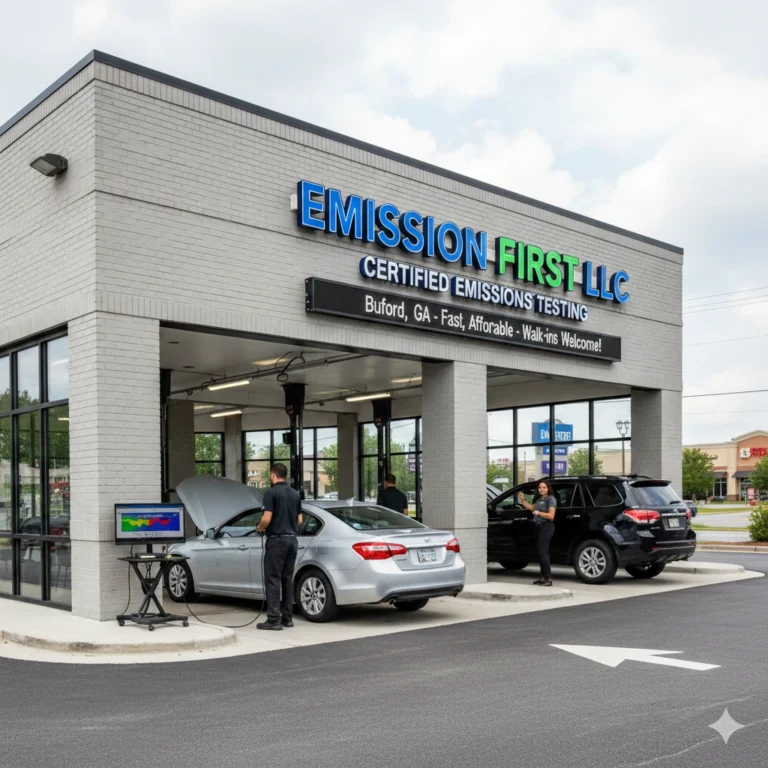
Modified or stock, the process at Emission First LLC is the same walk-in visit every time. No appointment, Monday through Saturday; the scan takes five to ten minutes, and you find out immediately whether you pass. If your vehicle has aftermarket parts and you are not sure where it stands, come in and ask before your registration deadline is close. We will tell you straight what the scanner is seeing.
Cash $14.99. Card $15.99. 3833 Buford Dr, Buford, GA 30519, next to Chevron.
Frequently Asked Questions
Will a cat-back exhaust fail my Georgia emissions test?
No. A cat-back system leaves the catalytic converter and every sensor ahead of it untouched, so it generally has no effect on the OBD scan result.
Will a muffler delete fail emissions in Georgia?
The catalytic converter stays intact with a muffler delete, so the emissions risk is low. The bigger risk is a separate noise citation under Georgia’s exhaust noise statutes.
Can I pass with a deleted catalytic converter?
No. A deleted cat fails the visual inspection and almost always triggers an oxygen sensor efficiency code on the OBD scan. This is an automatic and consistent fail.
Does a tune cause an automatic fail?
Not by itself. A performance tune that leaves all emissions sensors active typically does not cause a failure. What does cause a failure is testing too soon after the tune before your readiness monitors have completed a new drive cycle, or a tune specifically designed to mask a deleted emissions component.
Is it actually illegal to modify your exhaust in Georgia?
Modifying your exhaust to remove emission controls or exceed legal noise limits can lead to fines or inspection failures under both Georgia regulations and federal Clean Air Act tampering rules.
📍 Emission First LLC
3833 Buford Dr, Buford, GA 30519
Next to Chevron, Behind Cash Bucks Title Pawn, Beside Asia Grill Buffet
📞 +1 (470) 273 9500 💬 wa.link/udbyhf
Cash $14.99 Card $15.99 No Appointment Walk-ins Welcome Mon through Sat