Catalytic Converter Stolen? Here Is Exactly What It Means for Your Georgia Emissions Test
You approach your car and immediately notice something is wrong.
Your car may start with a loud, harsh exhaust noise, or a neighbor may alert you after hearing it.
Your catalytic converter was stolen overnight.
Welcome to a problem that is more common in Gwinnett County than most people realize and one that has a direct, significant impact on your ability to pass your Georgia emissions test and renew your vehicle registration.
This guide covers everything Buford area drivers need to know when their catalytic converter is stolen. What it means for your emissions test. Why will you fail even before the scanner runs? What replacement options look like. How much does it typically cost? Whether it counts toward Georgia’s repair waiver. And the fastest path from discovering the theft to getting back on the road legally in Gwinnett County.
First, What Is a Catalytic Converter and Why Do Thieves Want It?
Before we delve into the implications of the emissions test, it is helpful to understand what was taken and why.
The catalytic converter is part of your car’s exhaust system, located between the engine and the muffler. Its main job is to turn harmful gases like carbon monoxide, hydrocarbons, and nitrogen oxides into less dangerous ones before they leave the tailpipe. It does this using a honeycomb structure coated with precious metals such as platinum, palladium, and rhodium, which help the chemical process.
These precious metals are very valuable. In recent years, platinum, palladium, and rhodium have sold for hundreds or even thousands of dollars per ounce. Depending on the vehicle, a catalytic converter can have one to seven grams of these metals. Thieves can use a battery-powered saw to steal a converter in less than two minutes, whether your car is in a driveway, parking lot, or on the street.
In the metro Atlanta area, including Gwinnett County, catalytic converter theft has been a persistent and growing problem. Certain vehicles are targeted far more often than others. Hybrid vehicles like the Toyota Prius are particularly vulnerable because their catalytic converters see less heat exposure during normal hybrid operation, preserving the precious metals at higher concentrations. Toyota Tacomas, Honda Elements, and many SUVs with high ground clearance are also frequent targets due to easy undercarriage access.
How the Georgia Emissions Test Checks for Your Catalytic Converter
Here is something most Gwinnett County drivers do not know until the situation arises: the Georgia emissions test is not just the OBD-II scanner plugged into your dashboard port.
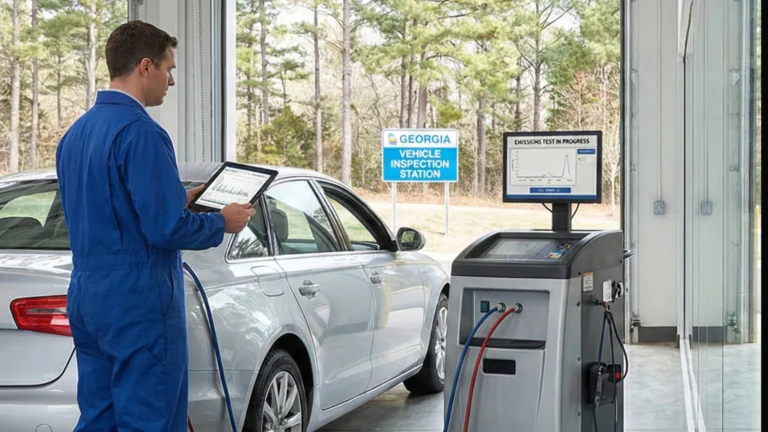
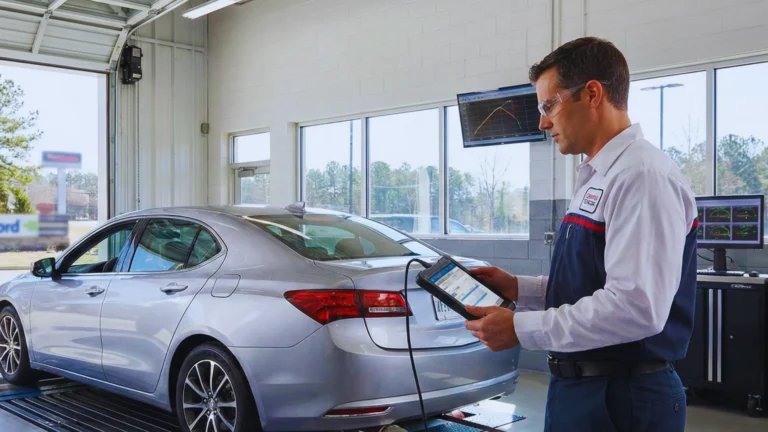
Every covered vehicle receives a three-part inspection. The centerpiece is an OBD test, which reads your vehicle’s built-in computer to check the emissions control system’s performance history. The inspector also checks your fuel cap for an adequate seal and does a visual inspection of the catalytic converter to confirm it has not been removed or tampered with.
Read that last part again. A visual inspection of the catalytic converter is a required component of the Georgia emissions test for every eligible vehicle.
This means that even if, hypothetically, your vehicle’s OBD system somehow had not yet detected the missing converter and stored an active code, the visual inspection would catch it. If your vehicle is a make and model year when catalytic converters came standard on the vehicle, make sure your vehicle has one and is not malfunctioning. If it does not have one or it is not working, it will not pass the test.
A missing catalytic converter is an automatic failure on the Georgia emissions test. There is no workaround, no exception, and no way to pass without one in place. And in practice, the OBD scanner will also have already flagged the absence of a stolen catalytic converter, which almost always triggers a check engine light within a short drive, which is its own automatic failure.
So you are dealing with two failure causes simultaneously: a missing component caught by the visual inspection, and almost certainly an active check engine light caught by the OBD scan.
What Happens to Your Check Engine Light When Your Cat Is Stolen
You will probably notice the check engine light come on if it has not already, within a short period of driving after the theft. Here is why.
Your vehicle’s downstream oxygen sensor, the one positioned after the catalytic converter in the exhaust path, monitors the converter’s efficiency by measuring the oxygen content of gases leaving it. When the catalytic converter is suddenly missing, the downstream oxygen sensor readings change dramatically. The OBD computer detects a massive deviation from expected values and stores an active diagnostic trouble code, most commonly P0420 (Catalyst System Efficiency Below Threshold, Bank 1) or P0430 (Bank 2).
With an active code and an illuminated check engine light, the OBD scan fails immediately. Combined with the visual inspection failure for the missing converter, your vehicle fails the emissions test on multiple grounds simultaneously.
This is why driving your vehicle to an emissions station immediately after a catalytic converter theft is not going to help, even if you are not sure whether to go in and try. You will fail. Every time. The repair has to happen first.
Your Immediate Steps After Discovering the Theft
The morning you discover your catalytic converter was stolen is a stressful one. Here is the practical order of operations that makes the situation as manageable as possible.
Step 1: Do not drive the vehicle unnecessarily.
A vehicle with a missing catalytic converter produces exhaust that goes directly from the manifold into the atmosphere without filtering. Beyond the environmental issue, the roaring exhaust noise can attract law enforcement attention, and in some configurations, unfiltered exhaust can create carbon monoxide exposure risks depending on how exhaust enters the cabin area. Drive only when necessary and with windows open until the repair is done.
Step 2: File a police report immediately.
Contact the Gwinnett County Police Department and file a theft report. Get a copy of the report number. You will need this for your insurance claim, and it creates a documented record of when the theft occurred, which can help with the repair waiver calculation if needed.
Step 3: Contact your insurance company.
Catalytic converter theft is typically covered under comprehensive auto insurance, not collision. Contact your insurer that same morning. They will want the police report number. Depending on your deductible and the replacement cost, filing a claim may or may not make financial sense. Get a repair estimate first so you can compare it to your deductible. If your deductible is higher than the repair cost, or if your insurance company denies your claim, you will need to pay for the replacement out of pocket. In that case, make sure to keep all receipts and documentation for your records and for any potential repair waiver application.
Step 4: Get a repair estimate from a licensed exhaust shop.
Call an exhaust specialist or a general repair shop that handles exhaust work. Be specific: tell them your vehicle’s year, make, model, and engine size, and tell them the catalytic converter was stolen. Ask for a written estimate that breaks out parts and labor separately. Keep this estimate even if you do not use that shop; it is documentation that may be relevant to your insurance claim and potentially to a repair waiver calculation.
Step 5: Authorize the replacement.
Once you have compared your estimate to your insurance deductible and decided how to proceed, authorize the repair. Keep every receipt itemized, showing parts cost and labor cost separately, on the shop’s letterhead with their business name and address.
How Much Does Catalytic Converter Replacement Cost in Gwinnett County?
This is the number everyone wants to know, and the honest answer is that it varies enormously depending on your vehicle.
Replacement costs for a stolen catalytic converter in the Gwinnett County and Buford area generally range as follows:
Economy sedans and compact cars (Honda Civic, Toyota Corolla, Hyundai Elantra): $400 to $800 for parts and labor using OEM or quality aftermarket converters.
Mid-size sedans and small SUVs (Toyota Camry, Honda Accord, Nissan Rogue): $600 to $1,200, depending on the specific converter configuration and whether direct-fit OEM parts are used.
Toyota Prius and other hybrids: This is where costs climb significantly. The Prius catalytic converter is one of the most stolen in the country and also one of the most expensive to replace. OEM Toyota converters for the Prius can run $1,500 to $3,000 or more for parts alone, with labor added on top. Aftermarket converters cost less but may not fully satisfy the OBD efficiency readings on high-sensitivity hybrid systems, something worth discussing with your mechanic before choosing the cheaper option.
Toyota Tacoma, Tundra, and similar trucks: $700 to $1,500, depending on whether a front or rear converter (some trucks have both) was stolen and the converter configuration.
Honda Element: $600 to $1,100 for standard replacement.
Ford F-150 and other light trucks: $500 to $1,200, depending on engine configuration and whether dual converters were taken.
One important note: Research your vehicle manufacturer’s recalls, Technical Service Bulletins, and warranties before getting any repairs done. In some cases, the cost of a repair may be covered by the manufacturer under a defect or recall. Additionally, federal law requires that catalytic converters on 1995 and newer vehicles be warranted by the manufacturer for eight years or 80,000 miles. If your vehicle is within that mileage range, you should contact the dealer to check your options. However, it is important to understand that most warranties do not cover theft or stolen parts—they are typically limited to defects or failures due to normal use. Still, it is worth confirming with your dealer or manufacturer in case there are exceptions or in case other coverage applies.
Does a Stolen Catalytic Converter Replacement Count Toward the Georgia Repair Waiver?
This is a question worth understanding clearly, because the answer affects how you should document everything.
The Georgia repair waiver allows drivers who have spent a qualifying amount on emissions-related repairs without achieving a passing result to renew their registration anyway for one year. The 2026 threshold is $1,176 in documented qualifying repairs.
A catalytic converter is unquestionably an emissions-related component — it is literally the primary emissions control device on a gasoline vehicle. Replacement of a stolen catalytic converter qualifies as an emissions-related repair for waiver purposes.
However — and this is important — the waiver is designed for situations where a vehicle has already been tested, failed, had repairs done, been retested, and still cannot pass after spending the threshold amount. It is not a substitute for actually replacing the catalytic converter and passing.
In most cases, a properly replaced catalytic converter will allow the vehicle to pass the emissions test once the OBD monitors have had time to reset and complete their cycles. The waiver becomes relevant only if, after a proper replacement, the vehicle still cannot achieve a passing result due to additional issues that emerge during retesting.
What you should do regardless: document every dollar. The police report, the insurance claim paperwork, the repair estimate, the itemized repair receipt, all of it. If, for any reason, the replacement does not fully resolve the OBD issue and you need additional repairs, that documentation supports your waiver application. For the full guide on the waiver and what happens when repairs are extensive, read our complete failure guide: My Car Failed the Emissions Test in Georgia. Here Is Exactly What to Do Next.
OEM vs Aftermarket Catalytic Converter: What Matters for the Emissions Test
When your converter is replaced, your shop will likely offer you a choice between an OEM (original equipment manufacturer) converter and an aftermarket one. This is a decision worth understanding before you authorize the repair, because the choice can affect whether your vehicle passes the Georgia emissions test.
OEM catalytic converters are manufactured to the exact specifications of the original part that came with your vehicle. They are designed to match the precise oxygen storage capacity and conversion efficiency your vehicle’s OBD system was calibrated to expect. OEM converters are more expensive, but they are the lowest-risk option for passing the Georgia OBD efficiency test, especially on newer vehicles with tighter tolerance windows.
Aftermarket catalytic converters vary widely in quality. High-quality direct-fit aftermarket converters from reputable manufacturers like MagnaFlow or Walker can perform comparably to OEM on many vehicles and cost significantly less. However, lower-quality aftermarket converters, particularly those that are not California Air Resources Board (CARB) compliant, may not achieve the efficiency threshold your vehicle’s OBD system expects, resulting in a P0420 or P0430 code after the repair.
For most standard gasoline vehicles, Camrys, Accords, Civics, F-150s, a quality direct-fit aftermarket converter is generally a reliable and cost-effective choice. For hybrid vehicles like the Prius, where the OBD sensitivity is higher and the efficiency threshold tighter, the OEM converter is the safer choice to avoid follow-up OBD failure codes after replacement.
Ask your mechanic specifically: “Will this converter clear the P0420 code on my vehicle?” A good exhaust specialist will know the answer based on your specific vehicle and their experience with Georgia emissions retesting.
After the replacement, do not come straight to the Emissions Station.
This is the same advice we give for any repair that involves the catalytic converter or code clearing, and it applies directly to post-theft replacement.
After your new catalytic converter is installed, your mechanic will clear the stored OBD codes. This resets your readiness monitors to incomplete. The catalyst monitor, which specifically evaluates whether your new catalytic converter is performing at the required efficiency, typically takes the longest to complete of all the monitors. It requires sustained highway driving under normal operating conditions.
Make sure your repair technician completes the Emissions Repair Form that was given to you when your vehicle did not pass. You will need a completed Emissions Repair Form to get your free retest after the repairs have been performed. emissionfirst
After the repair:
Drive normally for one to two weeks. Include regular highway driving at sustained speeds. The catalyst monitor specifically needs to see the converter operating at temperature under load to complete its evaluation cycle.
Keep your fuel level between a quarter and three-quarters full. This supports the EVAP monitor, which also needs to be completed.
Check your readiness monitors before coming in. Use a basic OBD-II scanner or visit any auto parts store for a free scan. When all applicable monitors show ready, and the check engine light is off, come to Emission First LLC.
For a complete guide on understanding and completing your readiness monitors, read: OBD Readiness Monitors The Hidden Reason Your Car Fails Georgia Emissions Testing.
How to Protect Your Catalytic Converter From Being Stolen Again
Once you have been through this experience once, protecting against it happening again becomes a priority. Here are the practical options Gwinnett County drivers use.
Anti-theft shields and cages. Physical steel cages and plates that mount around the catalytic converter, making it significantly harder to cut. Products like Cat Shield, CatClamp, and MillerCAT are popular and available through mechanics or online. They do not make theft impossible, but add enough time and noise to deter most opportunistic thieves.
Paint marking. Some law enforcement agencies and auto shops offer catalytic converter etching or painting programs where the converter is marked with your VIN or a unique identifier. This reduces the converter’s value on the scrap market since marked converters are easier to flag as stolen. The Gwinnett County Police Department periodically runs catalytic converter marking events; check their community calendar.
Parking strategy. Thieves prefer vehicles parked in poorly lit areas with easy undercarriage access. Parking in a well-lit garage or a highly visible parking area with cameras significantly reduces your risk. If you drive a Prius, Honda Element, or Toyota Tacoma, the three most frequently targeted vehicles in the Atlanta metro, this is especially important.
Vehicle alarm with tilt or vibration sensors. Standard alarms that only detect door or window intrusion will not trigger when someone crawls under your car with a saw. An aftermarket alarm with a tilt sensor or vibration sensor will detect the physical intrusion from below and trigger the alarm.
Vehicles Most Frequently Targeted in Gwinnett County
If you drive one of these vehicles, you are at a higher risk and should prioritize converter protection:
Toyota Prius (2004–2020): The most targeted vehicle for catalytic converter theft in the country. The Prius converter contains higher concentrations of precious metals due to lower heat exposure in hybrid operation. The Prius also has two converters on some model years.
Toyota Tacoma (2003–2021): High ground clearance makes undercarriage access fast and easy. Popular target in suburban and commercial parking areas.
Honda Element (2003–2011): The Element sits high enough for easy access. Converters are frequently targeted due to their precious metal content and accessibility.
Toyota 4Runner (2003–2020): Same high-clearance vulnerability as the Tacoma.
Ford F-250 and F-350 (diesel models are exempt from emissions testing, but the gasoline F-250 is rare and its converter can be targeted).
Toyota Sequoia and Tundra: High ground clearance and valuable converters make these frequent targets.
Lexus RX (2004–2020): Higher-end vehicles with valuable converters.
If you drive any of these in Gwinnett County, take the protection steps above seriously. The replacement cost alone, especially for the Prius, makes prevention significantly more economical than recovery.
Getting Your Registration Back on Track After Catalytic Converter Theft in Buford
Here is the complete path from the morning of the theft to your passing emissions certificate at Emission First LLC.
Day of theft: File police report. Call insurance. Stop driving the vehicle beyond necessity.
Days 1 to 3: Get repair estimates. Decide on insurance claim vs out-of-pocket. Authorize replacement with a licensed exhaust shop.
After repair: Drive normally for one to two weeks. Include highway driving. Keep fuel between a quarter and three-quarters full.
Before coming in: Check readiness monitors; all applicable ones should show ready, and the engine light should be off.
Walk into Emission First LLC at 3833 Buford Dr, Buford, GA 30519. No appointment. Monday through Saturday. The scan runs 5 to 10 minutes. Pass your certificate is in the Georgia DOR database immediately, and you can renew your registration online the same day.
If your registration deadline is imminent and the repair timeline is tight, visit the Gwinnett County Tag Commissioner’s office about a 30-day temporary registration extension. This buys you additional time to complete the repair and get back in for your retest.
For a full explanation of how the registration renewal process works after your test is complete, read: How to Renew Your Car Registration in Gwinnett County, GA Complete 2026 Guide.
And if your vehicle fails the retest for any reason, perhaps the new converter has not yet cycled through the monitors. Read: How to Prepare for Your Georgia Emissions Test and Pass First Time.
Frequently Asked Questions: Catalytic Converter Theft and Georgia Emissions Test
Will my car fail the Georgia emissions test with a stolen catalytic converter? Yes on two counts. The Georgia emissions test includes a visual inspection of the catalytic converter to confirm it has not been removed or tampered with. A missing converter fails this visual inspection. The missing converter also almost always triggers a check engine light from P0420/P0430 codes, which is a second automatic failure.
Can I drive my car after the catalytic converter was stolen? You can drive it, but it is not advisable for extended periods. The exhaust bypasses the converter and goes directly into the atmosphere. The vehicle is extremely loud, and in some configurations, exhaust fumes can enter the cabin more easily. Drive minimally and with windows open until repaired.
Does catalytic converter replacement count toward the Georgia repair waiver? The catalytic converter is an emissions-related component, so its replacement qualifies as an emissions repair for waiver documentation purposes. However, in most cases, a properly replaced converter allows the vehicle to pass; the waiver is most relevant if additional issues prevent passing after replacement.
How long after replacement before I can come in for my emissions test? Drive normally for one to two weeks after replacement. The catalyst monitor needs sustained highway driving under normal conditions to complete. Check your OBD readiness monitors before coming in. When all show ready, and the check engine light is off, you are ready to test.
OEM or aftermarket catalytic converter for the emissions test? For most standard gasoline vehicles, a quality direct-fit aftermarket converter passes without issue. For hybrid vehicles, especially the Toyota Prius, the OEM converter is the safer choice to avoid follow-up OBD efficiency code failures.
Where do I get my emissions test done in Buford after catalytic converter replacement? At Emission First LLC, 3833 Buford Dr, Buford, GA 30519. Walk in Monday through Saturday, no appointment, $14.99 cash or $15.99 card. Results in the state database immediately.
Come In Once Your Repair Is Done and Your Monitors Are Ready
Catalytic converter theft is a genuinely stressful experience, with the unexpected cost, the inconvenience, and the violation of having your car targeted. Once the repair is behind you and your monitors have had time to reset, the emissions test at Emission First LLC is the fast, straightforward final step back to a legal registration.
Walk in any time Monday through Saturday at 3833 Buford Dr, Buford, GA 30519. No appointment. The scan takes 5 to 10 minutes. If you pass and with a proper replacement and completed monitors, you should have your certificate in the Georgia DOR database before you reach the Buford Drive on-ramp.
📍 Emission First LLC 3833 Buford Dr, Buford, GA 30519 Next to Chevron · Behind Cash Bucks Title Pawn · Beside Asia Grill Buffet
📞 +1 (470) 273-9500 · 💬 wa.link/udbyhf
Cash $14.99 · Card $15.99 · No Appointment · Walk-Ins Welcome Mon–Sat