My Car Failed the Emissions Test in Georgia: Here’s Exactly What to Do Next
You walked in feeling sure of yourself. You walked out holding a piece of paper you didn’t want.
This happens to plenty of good drivers, so if you’re dealing with it, you’re not alone. The first thing to know is that failing an emissions test isn’t the end of the road. It’s just a detour, and it’s usually shorter and less expensive than it seems at first.
The problem is that most drivers have no idea what the actual next steps are. They know they failed. They know they need to renew their registration. Beyond that, the process gets murky fast. What do you do with the Vehicle Inspection Report? Who do you call? How long do you have? What if repairs cost more than the car is worth? To make it easier, here is the process in a nutshell: read your inspection report, check for any warranty coverage, get a professional diagnostic, complete repairs with proper documentation, and return for your retest.
This guide answers every one of those questions clearly. If your car just failed the emissions test in Georgia, here is exactly what to do, in order, starting right now.
First — Read Your Vehicle Inspection Report Carefully
The moment your vehicle fails the emissions test at any GCAF-certified station, including Emission First LLC in Buford, GA, you receive a Vehicle Inspection Report, or VIR. This document is more important than most drivers realize at the moment.
Do not leave without it. Do not fold it up and throw it in the glove box without reading it.
Your VIR tells you specifically which system or diagnostic code caused the failure. It is not just a pass-fail stamp. It is a roadmap. When you take your car to a mechanic, the VIR tells them exactly what to look at first, which saves you diagnostic time and money. It is also required for your free retest after repairs are completed, and it is required if you ever need to apply for a repair waiver.
The most common failure codes drivers in Buford and Gwinnett County see on their VIRs include oxygen sensor failures, evaporative system leaks, catalytic converter degradation, incomplete readiness monitors, and active check engine light codes.
Second — Check Your Manufacturer’s Warranty Before You Pay Anything
Before you call a repair shop, check one thing first.
Before you go anywhere, check to see if your vehicle is still covered by a manufacturer’s emissions control warranty. All new vehicles typically come with some type of emissions control warranty. If so, take it to an authorized dealer. Clean Air Force
Federal law requires manufacturers to warrant emissions control systems on 1995 and newer vehicles for at least two years or 24,000 miles. The OBD computer and catalytic converter on those same vehicles must be warranted for eight years or 80,000 miles. Many manufacturers extend these warranties beyond the federal minimums.
If your vehicle is within warranty range, an authorized dealer may cover the repair at zero cost to you. That is the first call to make, not a repair shop, not a parts store. Check your owner’s manual or call the manufacturer directly to confirm current warranty coverage for your specific vehicle and mileage.
If you are out of warranty, move to the next step.
Third — Get a Proper Diagnostic Analysis
Here is something that surprises many drivers: the emissions test is not a diagnostic.
The OBD-II scan reads what your car’s computer has recorded. It tells you and your technician what failed, but it does not tell you why or what the underlying mechanical cause is. For that, you need a diagnostic analysis from a qualified mechanic.
After your vehicle fails the initial test, the first step is to receive a comprehensive diagnostic analysis, which is necessary to identify the issue with your emissions control system or engine before a repair recommendation can be made. You can expect to be charged for the diagnostic analysis. However, the fee will apply toward your repair waiver requirements if needed. Clean Air Force
That last point matters; the diagnostic fee counts toward the 2026 repair waiver threshold, which we will cover in detail shortly. So even if repairs turn out to be expensive, the diagnostic cost is not wasted money.
When choosing a mechanic, ask whether they are ASE certified specifically in A6, A8, and L1 categories, which cover engine performance, engine controls, and advanced engine performance. A shop with these certifications has specifically trained technicians in the area most relevant to emissions failures.
Fourth — Make Sure Your Mechanic Completes the Emissions Repair Form
This is the step that trips up a significant number of drivers on retest day, and it is completely avoidable with one sentence to your mechanic.
Make sure your mechanic completes the Emissions Repair Form that was given to you when your vehicle did not pass. No re-inspection, whether paid or unpaid, will be performed until the vehicle has been repaired and the Emissions Repair Form has been completed. Clean Air Force
When you go back to Emission First LLC or any GCAF-certified station for your retest, you must present a completed Emissions Repair Form. Without it, the retest cannot happen, full stop. Hand the form to your mechanic at the start of the repair visit, not at the end.
Also, keep every receipt from every repair. Itemized receipts showing parts, labor, and the repair facility’s name and address are required if you end up applying for a repair waiver. Receipts from unlicensed shops may only have parts costs counted, not labor. Use a licensed repair facility.
Fifth — Return for Your Retest
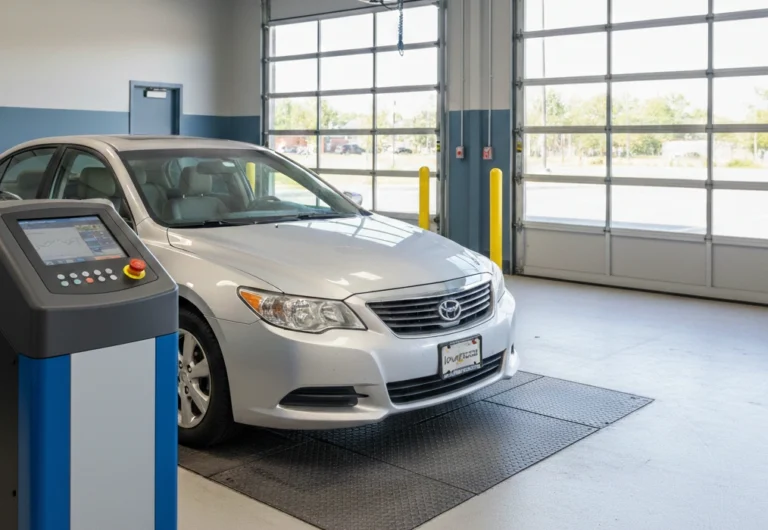
Once the repairs are complete and the Emissions Repair Form is filled out, return to a GCAF-certified station for your retest. At Emission First LLC at 3833 Buford Dr in Buford, GA, retests are handled exactly like first-time tests, walk in Monday through Saturday, no appointment needed, and the scan runs in 5 to 10 minutes.
The retest checks the same systems that failed on your original inspection. Your repaired vehicle needs to pass those areas, and it also needs to continue passing anything it originally passed.
If you pass, your result goes into the Georgia DOR database immediately, and you can renew your registration online the same day.
If your vehicle needs additional repairs before it can pass, the process repeats. Additional repairs and retesting may be required. Sometimes a series of repairs is needed to pass the re-inspection, which is less likely if your vehicle is properly maintained. Clean Air Force: Keep all documentation from every attempt, because each repair receipt can potentially count toward the repair waiver threshold.
What Is the 2026 Georgia Emissions Repair Waiver?
This is the option most drivers in Gwinnett County do not know exists and it can be a genuine financial lifeline when repairs are expensive, and the vehicle still cannot pass.
If your car fails the emissions test and you have spent a significant amount on qualified repairs without achieving a passing result, you may qualify for a one-year repair waiver that allows you to renew your registration despite not passing.
For 2026, the qualifying requirements are:
The cost of emissions-related repairs must meet or exceed the repair waiver minimum amount of $1,176 for 2026 registration. The retested vehicle must show improvement in all areas it initially failed. The retested vehicle must still pass the areas it originally passed. Clean Air Force
The $1,176 threshold is adjusted annually based on the Consumer Price Index. It applies per registration year — meaning it resets each year when your registration comes due again.
What counts toward the $1,176 threshold:
- Diagnostic analysis fees
- Parts costs for emissions-related repairs
- Labor costs — but only from licensed repair facilities
- Multiple repair attempts, as long as each receipt is dated within 60 days before or after a corresponding failed emissions test
What does NOT count:
- Labor from unlicensed shops
- Repairs done yourself (only parts costs count for DIY)
- Estimates — only completed repairs with receipts apply.
Repair waiver applications may be submitted electronically through the GCAF website, or you may print, complete, and submit the forms in person at any GCAF customer service center. If the application is approved, the approval will be sent electronically to the tag office to remove the emissions test hold on your vehicle. Clean Air Force
The repair waiver is not a permanent fix — it covers one registration year only. Next year, your vehicle must either pass or qualify for another waiver. It buys you time, not a permanent exemption.
The 30-Day Registration Extension — For Deadline Emergencies
If your registration deadline is approaching and your vehicle has failed, there is a short-term option that can give you breathing room while repairs are arranged.
If your vehicle fails its annual emissions inspection, please have all related taxes and fees ready. Then visit your local county tag office for information about a possible non-renewable 30-day extension on your registration per OCGA 40-2-20. Clean Air Force
This 30-day extension is not guaranteed it is issued at the tag office’s discretion and requires that all your taxes, fees, and insurance requirements are already met. It applies only to renewals, not new plate issuances. And it cannot be renewed — you get one 30-day window, not a series of extensions.
If your renewal deadline is less than a week away and your car just failed, go to the Gwinnett County Tax Commissioner’s office in Lawrenceville the same day or the next morning. Bring your failed VIR, your renewal notice, and payment for all taxes and fees. Request the 30-day extension. Then use those 30 days urgently — get the diagnostic done, authorize the repairs, and return for your retest as quickly as possible.
Do not treat this extension as a reason to slow down. Treat it as an emergency cushion that needs to be used immediately.
What Causes Most Failures — And How Expensive Are the Repairs?
After testing thousands of vehicles at Emission First LLC in Buford, the same failure causes appear over and over. Here is what they typically cost to fix and how long the repair takes.
Check engine light / active diagnostic code. This is the most common failure cause. The underlying issue ranges from a $12 gas cap replacement all the way to a $1,200 sensor or computer repair. Always start with a diagnostic to identify the specific code before authorizing any work.
Incomplete readiness monitors. This one costs nothing to fix and requires no mechanic. Drive the vehicle 50 to 100 miles under normal conditions,\ a mix of city and highway, and return for a retest once all monitors show complete. This situation typically occurs after a battery replacement or recent code clearing.
Failing oxygen sensor. Oxygen sensors typically cost $150 to $350 installed, depending on the vehicle and how many sensors need replacement. The repair is straightforward at most shops and usually resolves the failure in one visit.
Degraded catalytic converter. This is the most expensive common failure. Catalytic converter replacement typically runs $400 to $1,200 or more, depending on the vehicle, the converter type, and labor rates. High-mileage vehicles, particularly those over 120,000 miles, are most susceptible. If your vehicle is approaching the repair waiver threshold because of a catalytic converter replacement, make sure your shop is licensed and provides itemized receipts.
EVAP system leak or loose gas cap. Gas cap replacement costs $10 to $20 at any auto parts store. If the EVAP system has an actual leak, diagnosis and repair typically run $100 to $400, depending on which component failed.
For a detailed pre-test checklist to avoid failures on your first visit, see our guide:How to Know If Your Car Will Pass the Emissions Test Before You Go.
What If You Cannot afford the Repairs?
This is a hard situation, and it is worth being honest about.
If your vehicle fails the emissions test and the repair cost exceeds the vehicle’s value, you have a few realistic options.
Option 1 — Apply for the repair waiver. If you can spend $1,176 on repairs and your vehicle shows improvement, the waiver gives you one more registration year. This buys time to save for either further repairs or a vehicle replacement.
Option 2 — Investigate manufacturer warranty coverage. If you have not checked this yet, do it now. A dealer-covered repair changes the entire financial picture.
Option 3 — Sell or trade the vehicle. Vehicles being sold privately in Georgia require a passing emissions certificate, but dealers purchasing trade-ins handle this differently. Consult with a dealer about your options before investing further in a failing vehicle.
Option 4 — Research non-conforming vehicle status. GCAF has a process for vehicles that cannot pass due to the unavailability of parts or other documented non-conforming circumstances. This is a narrow category, but worth exploring if your vehicle qualifies.
What is not a viable option is simply driving on expired registration, hoping not to get caught. The fines for expired registration in Georgia, the insurance complications from operating an unregistered vehicle, and the compounding late fees make that path far more expensive than any repair.
The Fastest Path From Failure to Passing in Gwinnett County
Here is the cleanest version of the process if your vehicle just failed and your registration deadline is approaching.
Today: Read your VIR. Check the manufacturer’s warranty. If within warranty, call the dealer. If not, call a licensed ASE-certified repair facility and book a diagnostic appointment as soon as possible.
This week: Get the diagnostic done. Review the repair estimate. Authorize the repairs. Hand the Emissions Repair Form to your mechanic at the start of the repair visit. Keep all receipts.
Once repairs are complete, drive to Emission First LLC at 3833 Buford Dr, Buford, GA. Walk in Monday through Saturday, no appointment. Retest in under 10 minutes. If you pass, renew your registration online the same day.
If your deadline is days away: Go to the Gwinnett County Tag Commissioner’s office today and request the 30-day extension while you arrange repairs. Do not wait.
Frequently Asked Questions — Failed Emissions Test in Georgia
How long do I have to fix my car after failing the emissions test in Georgia? There is no hard deadline tied specifically to the repair; your deadline is your registration renewal date. If that date passes without a passing certificate, your registration expires, and late penalties apply. Test and repair as early as possible to give yourself maximum buffer. GCAF recommends testing four to six weeks before your renewal date for exactly this reason.
Can I drive my car after failing the emissions test in Gwinnett County? Yes, a failed emissions test does not make your vehicle illegal to drive. It makes your registration unable to be renewed until you pass or qualify for a waiver. As long as your current registration has not yet expired, you can continue driving while arranging repairs.
How much is the repair waiver threshold in Georgia for 2026? The repair waiver minimum amount is $1,176 for 2026 registration. This amount is adjusted annually to reflect changes in the Consumer Price Index. Clean Air Force
Does the diagnostic fee count toward the repair waiver? Yes. The diagnostic analysis fee counts toward the $1,176 threshold as long as it is performed at a licensed repair facility and you have an itemized receipt.
Can I get a free retest after repairs? You are entitled to a retest after completing documented repairs. Bring your completed Emissions Repair Form and your original VIR. The retest process at Emission First LLC is the same as any walk-in visit, with no appointment.
What if my car fails the retest, too? Continue the repair process and accumulate repair receipts. Once your total reaches the $1,176 threshold, apply for the repair waiver through the GCAF website or at a GCAF customer service center.
My registration deadline is tomorrow, and my car just failed. What do I do right now? Go to the Gwinnett County Tag Commissioner’s office first thing tomorrow morning with your failed VIR and payment for all taxes and fees. Request the 30-day extension per OCGA 40-2-20. Then immediately begin the repair process during that extension window.
Get Your Retest Done Fast at Emission First LLC
Once your repairs are complete, come straight to Emission First LLC for your walk-in retest. No appointment, no scheduling, no waiting for a slot.
We test Monday through Saturday at 3833 Buford Dr, Buford, GA 30519
The retest takes 5 to 10 minutes. If you pass, your result goes into the Georgia DOR database immediately, and you can renew your registration online the same day.
📍 Emission First LLC — 3833 Buford Dr, Buford, GA 30519
📞 +1 (470) 273-9500 · 💬 wa.link/udbyhf
Cash $14.99 · Card $15.99 · Walk-In Mon–Sat · No Ap