Your First Georgia Emissions Test: What to Expect and How to Get Through It Fast in Buford
Most people feel a little uncertain the first time.
You got the registration renewal notice, checked the box labeled “emissions test required,” and found the closest station on Buford Drive. Now you are sitting in your driveway, wondering what will happen when you pull in.
Is it like a car inspection where you drop the car off for hours? Do you need an appointment? Do they lift the car? Does it involve any kind of physical test where your car might fail just from sitting in idle? Do you wait inside or stay in the car? How do you know if you passed? What does the certificate look like?
These are completely reasonable questions, and the honest answer is that most first-timers feel noticeably more confident after their first visit than before it. Because the process is actually quite simple once you know what to expect. Most customers at Emission First LLC on Buford Drive are done and driving away in under 15 minutes after they pull in.
This guide walks you through every single step of your first Georgia emissions test from the moment you decide to go in, all the way to walking out with your certificate in hand. No assumptions. No skipped steps. Everything a first timer in Buford, Sugar Hill, Suwanee, Flowery Branch, or anywhere across Gwinnett County needs to know before they pull into an emissions station for the first time.
Does Your Vehicle Actually Need a Georgia Emissions Test?
Before you drive anywhere, this is the first thing to confirm. Not every vehicle registered in Gwinnett County requires the annual emissions test.
For 2026 registrations, all 2002 through 2023 model year gasoline-powered cars or light trucks up to 8,500 lbs must have a valid Georgia emission inspection. An emission inspection must be completed prior to submitting a vehicle renewal to receive a registration decal.
Your vehicle needs the annual Georgia emissions test if all four of these are true.
It is a gasoline-powered car or light-duty truck. It weighs 8,500 lbs or less based on the manufacturer’s gross vehicle weight rating. It is model year 2002 through 2023. It is registered in Gwinnett County or one of the other 12 covered metro Atlanta counties.
Your vehicle does not need the test if it is model year 2024 or newer, model year 2001 or older, diesel-powered, fully electric, a motorcycle, or an RV. Your registration renewal notice will clearly indicate whether an emissions test is required for your specific vehicle before renewal can be processed.
If you are not sure, your renewal notice is the most reliable confirmation. The Georgia Department of Revenue knows your vehicle’s model year, fuel type, and registration county and will flag whether a test is required.
Your First Step: The Dashboard Check the Night Before
Before you go anywhere, do one thing tonight.
Go out to your car, get in, and look at your dashboard. Turn the key to the first position where the electronics come on, but the engine is not yet running. Look at every indicator light. They should all come on briefly during the start sequence and then go off.
The one that matters most is the check engine light. It typically looks like a small engine outline or says CHECK ENGINE, depending on your vehicle.
An emission inspection must be completed prior to submitting a vehicle renewal to receive a registration decal. But more specifically, if your check engine light is on when you pull into any emissions testing station in Gwinnett County, your vehicle will fail the test automatically and immediately. The scanner will detect the active fault code in your vehicle’s computer and issue a failure before the scan even finishes evaluating anything else.
If the check engine light is off on a normally running vehicle, you are in good shape to come in.
If it is on, do not come in yet. Head to any auto parts store in Buford first and ask them to read the diagnostic code for free. Understanding what triggered the light is the right starting point before spending money on a test you will fail.
What to Bring to Your First Georgia Emissions Test
Here is the straightforward answer: almost nothing.
You do not need to bring your registration papers. You do not need to print anything out in advance. You do not need a form filled out ahead of time. You do not need an appointment confirmation because there is no appointment system at Emission First LLC.
What you do need is your vehicle and your payment.
At Emission First LLC on Buford Drive, the emissions test costs $14.99 cash or $15.99 by card, including Apple Pay. Know which you are paying with before you pull in. That is genuinely the only thing to have ready.
Some first-timers think they need to bring their registration renewal notice or their vehicle title. You do not. The testing station only needs the vehicle itself to run the OBD-II scan. All the documentation flows electronically to the state system after the test.
Your fuel level matters slightly more than people realize. GCAF recommends that for most vehicles, having the fuel level between 25 percent and 75 percent full supports the completion of the EVAP readiness monitor. You do not need to be precise about this, but arriving with a nearly empty or completely full tank is slightly less ideal than arriving with fuel somewhere in the middle. A half tank is perfect.
Finding Emission First LLC for the First Time
This is worth covering specifically because it catches a meaningful number of first-time visitors.
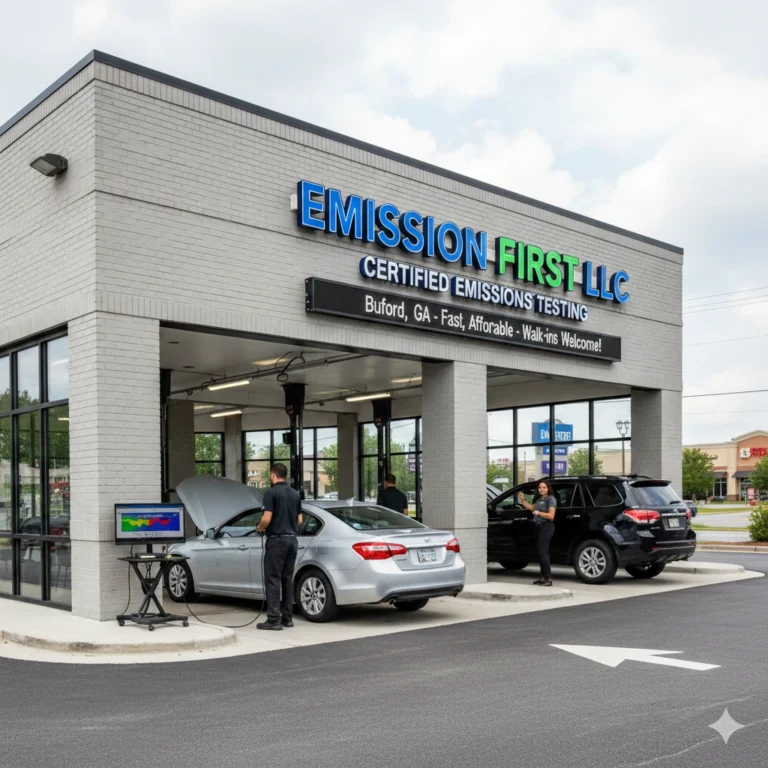
Emission First LLC is located at 3833 Buford Dr, Buford, GA 30519. The station sits next to the Chevron gas station on Buford Drive, directly behind Cash Bucks Title Pawn, and right beside Asia Grill Buffet.
The important navigation note: some GPS apps route drivers to the Walmart parking lot nearby. That is not correct. Do not follow the GPS to Walmart. Look for the Chevron station on Buford Drive and turn toward it. Emission First LLC is attached right next to the Chevron canopy.
Once you are on Buford Drive and you can see the Chevron sign, you have found us. Pull past the pumps and into our testing bay. The access is clear and straightforward.
What Happens the Moment You Pull In
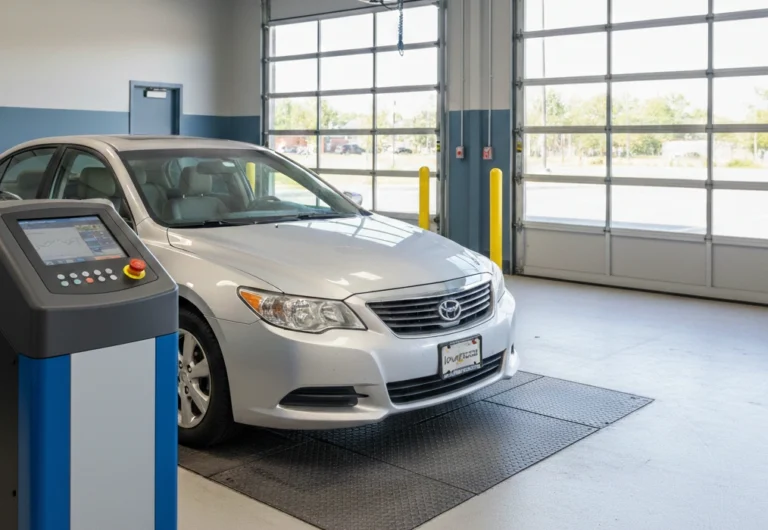
You do not check in at a front desk. You do not fill out paperwork in a waiting room. You do not schedule a slot. You pull your vehicle into the testing bay, and a certified technician comes to you.
Here is exactly what happens from the moment your car enters the bay.
The technician will approach your vehicle and greet you briefly. This is a routine process they do dozens of times every day. There is nothing for you to explain or describe unless you have specific concerns you want to mention, which is always welcome.
They will ask you to remain in the vehicle or let you know whether to step out based on the specific setup of the bay. At most points during the scan, you simply sit comfortably while the technician works.
The OBD-II Scanner Connection
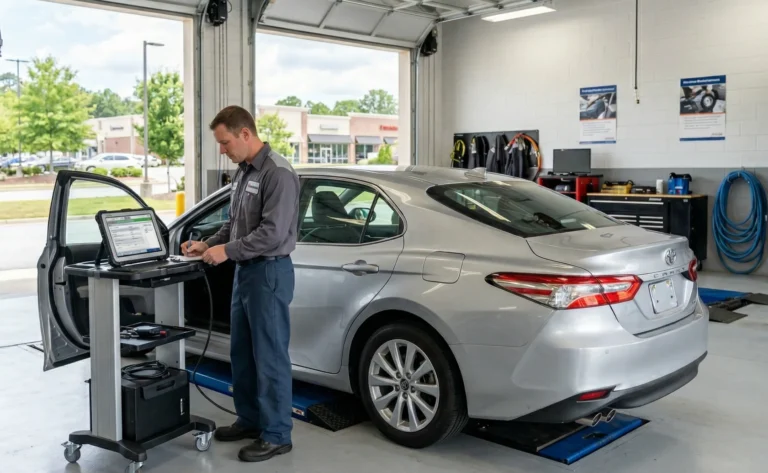
The first physical step of the test is connecting the diagnostic scanner to your vehicle.
Your vehicle has an OBD-II port, also called a data link connector, located beneath your dashboard near the steering column. On almost every passenger car and light-duty truck, it is within easy reach below the driver’s side dashboard and slightly to the left or right of center.
The technician plugs the GCAF-approved OBD-II scanner cable directly into this port. The connection is the same size and shape as a standard vehicle diagnostic port and plugs in with a firm click. There is nothing invasive about this. It is the same port your mechanic uses when they scan your car for trouble codes.
The entire connection process takes about 30 seconds.
The Gas Cap Check
While the scanner is running, the technician performs the second component of the Georgia emissions test: a check of your gas cap seal.
Every covered vehicle receives a three-part inspection. The centerpiece is an OBD test, which reads your vehicle’s built-in computer to check the emissions control system’s performance history. The inspector also checks your fuel cap for an adequate seal.
The technician removes your gas cap, visually inspects the rubber seal, and tests whether the cap creates an adequate seal when reinstalled. A gas cap with a cracked or dried-out rubber seal can fail the evaporative emissions system inspection.
This check takes less than a minute. If your gas cap passes, the technician reinstalls it and continues. If the seal is damaged, they will let you know. A replacement gas cap costs $10 to $20 at any auto parts store and is one of the cheapest possible emissions-related fixes available.
The Visual Inspection of the Catalytic Converter
The third component of the Georgia emissions test is a visual inspection of your catalytic converter to confirm it is present and has not been removed or tampered with.
The inspector also does a visual inspection of the catalytic converter to confirm it has not been removed or tampered with.
The technician will briefly check the underside of your vehicle to visually confirm the catalytic converter is in place. This is a quick look, not an extended mechanical inspection of your undercarriage. It takes about 30 seconds.
Catalytic converter theft has become a real issue in Gwinnett County, which is why Georgia added this visual check to the standard testing process. A vehicle with a missing catalytic converter fails this inspection automatically.
If your catalytic converter is intact, this component of the test is done in seconds, and you move straight to the results.
The OBD Scan Is Running: What Is Actually Happening?
While you are sitting comfortably in your car, the OBD-II scanner is reading data from your vehicle’s onboard computer. Here is what it is actually evaluating during those 5 to 10 minutes.
Malfunction Indicator Lamp status: The scanner first checks whether your check engine light is active. An illuminated check engine light means an active fault code is stored, and the test ends as a failure immediately.
Diagnostic trouble codes: The scanner reads all stored diagnostic codes in your vehicle’s computer memory, both active confirmed codes and pending developing codes. Active codes with an illuminated check engine light fail the test. Pending codes without an illuminated light do not fail the test but are noted.
Readiness monitor status: This is the component of the scan that most first-time visitors have never heard of before. Your vehicle’s computer runs a series of internal self-check tests on each emissions-related system. These tests are called readiness monitors, and they must show a completed status for the vehicle to pass. License plates can be renewed online using DRIVES e-Services, at a self-serve kiosk (if your county participates), or at your county tag office.
Georgia allows a maximum of one incomplete readiness monitor for 2001 and newer vehicles. If two or more monitors show as not ready or incomplete, the vehicle fails even with no check engine light and no stored codes.
The most common reason readiness monitors show as incomplete is a recent battery replacement or recent code clearing. If either happened to your vehicle in the last two weeks, the monitors may need additional driving time to reset. This is worth knowing before your first visit.
Your Results: What Happens Immediately After the Scan
When the scan finishes, the results are immediate. There is no waiting period, no coming back tomorrow, and no calling in two hours to find out. The technician can tell you the result the moment the scan completes.
There are two outcomes.
You passed. The technician confirms the pass result, and your Vehicle Inspection Report is issued. In most cases at Emission First LLC, this report is transmitted electronically to the Georgia Department of Revenue database within minutes of the test being completed. You do not need to mail anything, bring anything to the tag office, or submit any paperwork separately. The state receives your passing result automatically.
The emission inspection station that completes testing is required to electronically submit the test results to the Georgia Department of Revenue motor vehicle database.
This means you can go home, log into the Georgia DRIVES e-Services portal at drives.georgia.gov, enter your plate number and the last four digits of your VIN, and complete your registration renewal online the same afternoon. Your passing emissions result will already be on file in the system.
You did not pass. The technician explains what the scan found and what caused the failure. You receive a Vehicle Inspection Report that shows the specific code or system that failed. This report is your starting point for addressing the issue.
If You Pass: What to Do in the Next Hour
If you pass your first Georgia emissions test, the practical next step is equally simple.
Open your phone’s browser or go to a computer at home. Navigate to drives.georgia.gov. Enter your vehicle’s license plate number and the last four digits of your Vehicle Identification Number, which can be found on your registration renewal notice or on the dashboard plate visible through the windshield.
The system will pull your vehicle record, confirm your passing emissions result is on file, confirm your insurance status, and present your renewal fees for payment. Pay with a debit card, credit card, or electronic check. Your new registration and annual decal will arrive in the mail within two to three weeks.
That is the entire process. From pulling into Emission First LLC on Buford Drive to completing your registration renewal at home can happen in the same morning for most Gwinnett County drivers.
License plates can be renewed online using DRIVES e-Services, at a self-serve kiosk if your county participates, or at your county tag office.
If you prefer to renew in person rather than online, take your passing emissions report to the Gwinnett County Tag Commissioner’s office in Lawrenceville. You can also use a Georgia MV Express self-service kiosk at select locations around Gwinnett County if your county participates.
If You Do Not Pass: The Honest Next Steps
Failing your first emissions test is more common than the anxiety around it suggests, and it does not mean your car is falling apart. In most cases, it means one specific system has a detectable issue that needs to be addressed.
Here is what to do if your first test results in a failure.
Read your Vehicle Inspection Report carefully. It shows the exact code or monitor status that caused the failure. This document is your diagnostic roadmap. Take a photo of it on your phone before you leave the station.
Do not be hard on yourself or the car. The most common first-time failures are things that were already developing quietly without any obvious driving symptoms. A gas cap with a degraded seal. A readiness monitor that is incomplete because the battery was replaced two weeks ago. An oxygen sensor that was borderline for a while finally crossed the threshold.
Take the report to any licensed auto repair shop in the Buford area. Show them the specific code or monitor result. Ask for a written estimate for the repair. The report tells them exactly what to look at, which saves diagnostic time and money.
Once the repair is done, drive your vehicle normally for seven to ten days. This allows any readiness monitors that were reset during the repair process to complete their evaluation cycles. Then come back to Emission First LLC for your retest.
The retest process is identical to the original test. Walk in, no appointment, same cost, same scan. Most vehicles that have had the specific failing issue repaired and driven through a proper reset period pass the retest.
An emission inspection is valid for 12 months or for one registration renewal by the same owner. If your registration deadline is very close and you need more time for repairs, visit the Gwinnett County Tag Commissioner’s office and ask about a 30-day temporary registration extension. This extension is available for vehicles that have failed the emissions inspection and need time to arrange repairs before the registration deadline expires.
Common First-Timer Questions Answered
First-time visitors to any emissions testing station in Buford tend to ask the same questions. Here are the honest answers to the ones we hear most often at Emission First LLC.
Do I stay in the car the whole time? Typically yes. The OBD scan is done with you in the vehicle and the car in the testing bay. The technician works quickly, and the process does not require you to step out. Some stations may ask you to briefly exit during specific steps, but in general, you are simply sitting comfortably while the scan runs.
Does the engine need to be running during the test? The OBD-II scanner reads data that the vehicle’s computer has stored during previous driving cycles. The engine does not need to be running at the moment of the scan. The technician connects the scanner and reads the stored data directly from the computer memory.
How do I know if my car is ready before I come in? Check your dashboard for the check engine light. Think about whether your battery was recently replaced or if any codes were cleared in the last two weeks. Check your gas cap seal. Arrive with fuel somewhere between a quarter and three-quarters full. If all of those are in order, your vehicle is likely in good shape for its first test.
How long does the first test take? The actual scan runs for 5 to 10 minutes. Add a brief moment for the technician to connect the equipment, the gas cap check, and the catalytic converter visual inspection. Most first-time customers at Emission First LLC are fully done and driving away with their result in under 15 minutes total from pulling in.
Do I need to do anything different because it is my first time? Nothing whatsoever. The process is identical for every vehicle every time. A first-time visitor and a driver who has come in every year for a decade go through exactly the same steps.
Can I ask questions during my visit? Absolutely. The team at Emission First LLC is happy to explain anything about the process, what the result means, or what the next steps are if your vehicle does not pass. First-time visitors are welcome to ask anything before, during, or after the test.
What if I am nervous about the result? That is completely understandable. Most vehicles in reasonable condition pass the Georgia emissions test without issue. The scan is evaluating the health of your emissions control systems, not how the car looks or how old it is. A well-maintained vehicle of any age can pass cleanly.
When can I renew my registration after passing? The same day. Your result goes into the Georgia DOR database immediately after the test. Log into drives.georgia.gov, enter your plate number and last four VIN digits, and complete your renewal online within the hour.
The Best Time for Your First Visit to Emission First LLC
Since this is your first time, choosing the right moment makes the experience smoother.
Mid-week mornings are consistently the best window at Emission First LLC. Tuesday, Wednesday, or Thursday between 9 and 11 in the morning tends to see the least traffic. You will pull in, get started quickly, and be done in well under 15 minutes with no waiting.
The end of the month is the most crowded period at every emissions testing station in Gwinnett County. Drivers who waited until the last week before their registration deadline show up in volume. If your renewal deadline falls at the end of the month and you have any flexibility at all, coming in during the first two weeks of the month creates a noticeably smoother experience.
It is best to get your vehicle inspected four to six weeks before the registration renewal date, in the event repairs need to be made. Testing early gives you real buffer time if anything unexpected comes up. It is the same test, same cost, and same certificate regardless of when you come in. The only thing that changes is how much time you have before your deadline if you need to address repairs.
What Your Certificate Actually Looks Like
A lot of first-time visitors wonder what the actual proof of passing looks like and whether they need to do anything with a physical document.
Your Vehicle Inspection Report is a printed page that the testing station can provide upon request. It shows your vehicle’s information, the test date, the testing station, and the result. The passing result is noted clearly.
The honest answer for most Gwinnett County drivers in 2026 is that you will never actually need a physical copy of this document. The emission inspection station that completes testing is required to electronically submit the test results to the Georgia Department of Revenue motor vehicle database. The state already has your result on file the moment the test is complete. Online renewal through Georgia DRIVES pulls the result automatically. The tag office pulls it automatically. You do not need to hand anything over or submit anything manually.
Some drivers like to keep a photo of the VIR on their phone as personal documentation. That is a reasonable practice and takes five seconds. But from a practical standpoint, the certificate does its job automatically by existing in the state database, and you do not need to carry a physical copy anywhere.
After Your First Test: What to Know for Future Years
Now that you have been through the process once, the annual cycle is clear and consistent.
Your emissions certificate is valid for 12 months or one registration renewal by the same owner, whichever comes first. Every year, within a few weeks of your registration renewal deadline, you come back to Emission First LLC, walk in, get the scan done in under 15 minutes, and use the result to renew your tags.
The test is the same every year. The process is the same. The cost is $14.99 cash or $15.99 card. The only variable is whether your vehicle passes on the first visit, which, for a well-maintained vehicle in good running condition, is the typical outcome the vast majority of the time.
The single most useful habit to develop after your first test is testing early. Coming in four to six weeks before your registration deadline means that if something unexpected comes up on your second or third visit years from now, you have plenty of time to address it without deadline pressure.
Walk In Whenever You Are Ready
First visit or hundredth visit, the experience at Emission First LLC on Buford Drive is built around making the process as fast and stress-free as possible.
Walk in any time Monday through Saturday with no appointment needed. Pull into the bay, a technician will get you started immediately, and you will have your result in under 15 minutes. Cash $14.99. Card $15.99. Certificate in the Georgia DOR database the moment you pass.
It is one of the shortest errands on your registration renewal checklist. Now that you know exactly what to expect, it will feel that way from the moment you pull in.
📍 Emission First LLC 3833 Buford Dr, Buford, GA 30519 Next to Chevron, Behind Cash Bucks Title Pawn, Beside Asia Grill Buffet
📞 +1 (470) 273-9500 💬 wa.link/udbyhf
Cash $14.99 Card $15.99 No Appointment Walk-Ins Welcome Mon through Sat