What Does the Georgia Emissions Test Actually Check? The Honest Answer for Gwinnett County Drivers
Here is something a little uncomfortable to admit.
Most drivers who have been getting the Georgia emissions test done every year since the late 1990s have never actually stopped to ask what it measures. You pull in, a cable gets plugged into your car, something runs for a few minutes, and a printout says pass or fail. You pay $14.99, get back in your car, and go home to renew your tags online.
The test feels like a formality. Like paying a small annual toll to keep the government happy. Something you do because you have to, not because you understand why.
That is almost universal. At Emission First LLC on Buford Drive, we talk to hundreds of Gwinnett County drivers every year, and the vast majority have no idea what the scanner is actually reading when it is plugged into their car. They do not know what a readiness monitor is. They do not know what the scanner is looking for or what would make it report a failure. They have just been trusting the process for years.
That changes today. This guide explains in plain English exactly what the Georgia emissions test measures, why the state requires it, what the scanner is actually doing during those five to ten minutes it is connected to your vehicle, and why understanding this gives you a genuine advantage on test day and throughout the year.
Why Georgia Tests Cars in the First Place
Before getting into the mechanics of the test itself, the reason it exists matters. Without that context, the whole thing feels arbitrary.
In 1996, the federal Environmental Protection Agency designated 13 counties in and around metro Atlanta as severe nonattainment areas for ground-level ozone under the federal Clean Air Act. Nonattainment means those counties were producing more ozone-forming pollutants than federal clean air standards allow. The designation put Georgia under a federal mandate to reduce vehicle emissions in those counties or face consequences including the loss of federal highway funding.
Georgia’s response was the vehicle emissions testing program now administered by the Georgia Clean Air Force. The 13 covered counties are Cherokee, Clayton, Cobb, Coweta, DeKalb, Douglas, Fayette, Forsyth, Fulton, Gwinnett, Henry, Paulding, and Rockdale. Gwinnett County is on that list. Approximately 3 million vehicles are tested each year at nearly 700 certified inspection stations across the covered area.
Every vehicle that passes is a vehicle the state has confirmed is not producing emissions beyond the acceptable threshold. Every vehicle that fails and gets repaired before passing brings pollution output back within range. The aggregate effect across millions of vehicles tested annually is measurable improvement in air quality for everyone in the metro Atlanta area.
That is the why. Now here is the what.
What the Test Is Actually Measuring
The Georgia emissions test is not a single check. It is three distinct evaluations happening in sequence, and each one looks for something different.
Evaluation one: the Malfunction Indicator Lamp check.
The very first thing the testing equipment looks for when the scanner connects to your vehicle is whether your check engine light is on. The malfunction indicator lamp, commonly called the MIL, is your vehicle’s built-in warning system. When your car’s onboard computer detects a problem with any emissions-related system that is serious enough to confirm, it illuminates the check engine light and stores a diagnostic trouble code in memory.
An illuminated check engine light is an immediate automatic failure on the Georgia emissions test. There is no partial credit, no grace period, and no exception. The logic is straightforward. If your own vehicle’s computer is actively flagging a problem with an emissions-related system, the state cannot certify that vehicle as emissions compliant. The scanner does not need to evaluate anything further.
This is why the most important thing any Gwinnett County driver can check before heading to any testing station is their own dashboard. If the light is on, the test will fail.
Evaluation two: the OBD-II readiness monitor check.
This is the evaluation most drivers have never heard of, and the one that causes the most confusion when a vehicle fails without a check engine light.
Your vehicle’s onboard computer, called the OBD-II system, runs a series of internal self-check tests on each of its emissions-related systems continuously as you drive. Each of these self-checks is called a readiness monitor. There are monitors for the catalytic converter, the oxygen sensors, the evaporative fuel system, the exhaust gas recirculation system, the fuel system, and others depending on the vehicle.
Each monitor cycles through its evaluation over the course of normal driving and reports its status as either complete or not ready. The Georgia testing equipment reads the status of all applicable monitors on your vehicle. A lit check engine light results in automatic failure. For model year 1996 and newer vehicles, a technician connects an OBD-II scanner to the vehicle’s diagnostic port and checks for stored trouble codes, readiness monitor status, and the malfunction indicator lamp.
Georgia allows a maximum of one incomplete readiness monitor for 2001 and newer vehicles. If two or more monitors show as not ready, the vehicle fails even with no check engine light and no stored fault codes. This is why a vehicle that was running perfectly and just had its battery replaced or codes cleared can fail the test with no warning lights and no obvious symptoms. The reset event wiped the monitor statuses to incomplete, and the vehicle has not had enough normal driving time to cycle them back to complete.
Evaluation three: the visual catalytic converter inspection.
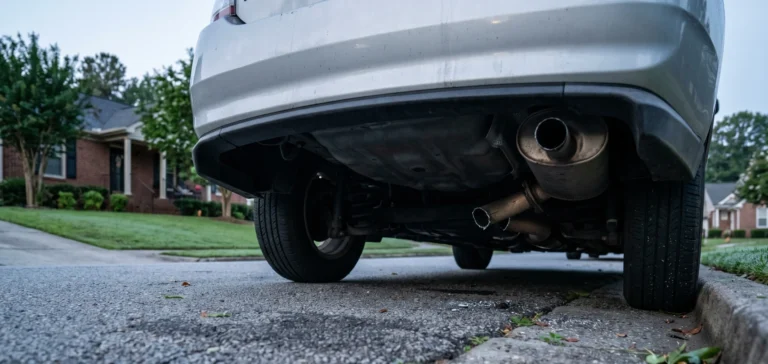
This one surprises a lot of drivers because it involves a technician physically looking at the underside of the vehicle. Georgia requires a visual confirmation that the catalytic converter is present and has not been removed or tampered with.
The catalytic converter is the component in your exhaust system that converts the toxic byproducts of combustion, primarily carbon monoxide, unburned hydrocarbons, and nitrogen oxides, into less harmful gases before they exit the tailpipe. It is the single most important emissions control component on a gasoline-powered vehicle.
Because catalytic converter theft has become a widespread problem across the Gwinnett County area, particularly targeting Toyota Prius, Toyota Tacoma, and Honda Element vehicles, the visual inspection catches stolen or removed converters that might not yet have triggered a check engine light in every scenario.
A missing catalytic converter fails the visual inspection immediately and consistently. It also almost always produces a P0420 or P0430 oxygen sensor efficiency code on the OBD scan, creating a simultaneous failure on both evaluations.
What the Scanner Is Reading: The Data Behind the Test
When the OBD-II scanner connects to the port under your steering column and runs its evaluation, it is communicating directly with your vehicle’s engine control unit. Here is what it is pulling from that communication in plain language.
Stored diagnostic trouble codes. These are the specific codes your vehicle’s computer has recorded when it detected a problem with any monitored system. Active codes are ones the computer has confirmed across multiple detection cycles and lit the check engine light for. Pending codes are ones the system detected once or twice but has not yet confirmed. Active codes cause an automatic failure. Pending codes are logged and noted but do not automatically fail the test.
Readiness monitor completion status. The scanner reads the binary status of each applicable monitor, complete or not ready, for your specific vehicle configuration. Different vehicles have different sets of applicable monitors based on their emissions control hardware. The scanner knows which monitors apply to your vehicle based on your VIN and checks each one.
The MIL command status. The scanner confirms whether the computer is commanding the check engine light to illuminate. This is checked directly from the computer rather than by looking at the dashboard, which means a check engine light that was bulb-burned or taped over does not bypass this check. The computer reports the command status regardless of whether the physical light is visible.
What the Test Is Not Measuring
This matters because a lot of Gwinnett County drivers arrive with assumptions about what the test does that are not accurate.
The Georgia emissions test does not check your vehicle’s brakes, your tire tread, your fluid levels, your alignment, your lights, or anything else related to general safety or mechanical condition. It is exclusively an emissions compliance check.
It does not test how clean your exhaust actually smells or appears. There is no tailpipe sniffing probe involved in the modern Georgia OBD-II test for 1996 and newer vehicles. The test reads your vehicle’s computer data, not the physical exhaust output. A vehicle with genuinely dirty exhaust can theoretically pass if the computer reports that all its emissions control systems are functioning within expected parameters.
It does not test how recently you did an oil change, whether your air filter is clean, or how old your spark plugs are. These matter for your vehicle’s long-term health and indirectly for emissions output over time, but they are not directly evaluated on test day.
It does not vary based on the station. The test at Emission First LLC in Buford and the test at any other GCAF-certified station in Gwinnett County are reading the same data from the same OBD-II port using the same approved equipment following the same Georgia Clean Air Force protocols. The test is standardized. The results are identical regardless of which certified station you use. The only variable is the price, and at Emission First LLC, the price is $14.99 cash.
How the Test Gives You Information About Your Car’s Health
Here is the part most drivers never consider. The Georgia emissions test is not just a compliance hurdle. It is a diagnostic data read on your vehicle’s emissions control systems, and that data is genuinely valuable whether you pass or fail.
When you pass the test cleanly, the scan result confirms that your vehicle’s onboard computer has no active fault codes, all applicable readiness monitors have completed their evaluation cycles and found no problems, and the catalytic converter is present and intact. That is a meaningful snapshot of your vehicle’s health that you paid $14.99 for. A clean pass on a high-mileage vehicle is genuinely useful information about where your emissions components stand.
When you fail, the Vehicle Inspection Report you receive tells you exactly which system failed and what the specific fault code is. This is diagnostic information you would pay $80 to $150 for at a mechanic for a code scan. The emissions test failure report essentially gives you that diagnostic data for the price of the test, pointing you directly at whatever your vehicle’s computer has identified as a problem.
Pending codes visible on the scanner but not yet triggering the check engine light are another layer of value. At Emission First LLC, when the scanner picks up pending codes on a vehicle that otherwise passes, the team mentions them to the customer as a heads-up. A pending code is your vehicle’s early warning that something is developing before it becomes an active fault that lights the check engine light and fails next year’s test.
The Three Emissions-Related Pollutants the Test Ultimately Exists to Reduce
Even though the modern Georgia test reads computer data rather than directly measuring exhaust output, the underlying pollutants it is designed to control are worth understanding because they connect the annual test to the air quality Gwinnett County residents breathe.
Carbon monoxide. CO is a colorless, odorless gas produced when gasoline combustion is incomplete. A properly functioning catalytic converter converts CO into carbon dioxide, which is significantly less harmful. A degraded or missing catalytic converter allows elevated CO levels to exit the tailpipe unfiltered.
Hydrocarbons. HC represents unburned fuel in the exhaust. It comes from incomplete combustion, evaporative fuel vapors from fuel system leaks, and combustion chamber inefficiency from worn spark plugs, degraded injectors, or other engine issues. The evaporative emissions control system, which the EVAP readiness monitor checks, is specifically designed to prevent fuel vapors from escaping the fuel system into the atmosphere.
Nitrogen oxides. NOx forms at high combustion temperatures and is the primary contributor to ground-level ozone formation in the Atlanta metro area. The exhaust gas recirculation system reduces NOx production by recirculating exhaust gas back into the engine to moderate combustion temperatures. The EGR readiness monitor checks whether this system is functioning correctly.
When your vehicle passes the Georgia emissions test, it is confirming through its own computer data that the systems designed to control all three of these pollutants are working within acceptable parameters. That confirmation, multiplied across the approximately 3 million vehicles tested annually in the metro Atlanta area, is what keeps the region in compliance with federal clean air standards.
Why Understanding the Test Makes You Better Prepared for It
None of this information is required to pass the emissions test. You can drive in, plug the cable in, and get your result without knowing any of it.
But knowing it gives you specific advantages.
You know why the check engine light is an automatic failure, so you check your dashboard before making the drive instead of after.
You know why a battery replacement or code clearing resets readiness monitors, so you wait the appropriate 7 to 10 days of normal driving before coming in instead of showing up immediately after the repair and failing for incomplete monitors.
You know why the gas cap matters to the EVAP monitor, so you take 30 seconds to check and reinstall it firmly the night before your test instead of failing for a $12 gas cap seal.
You know why the catalytic converter visual inspection exists, so if you drive a high-theft-risk vehicle like a Prius or Tacoma, you confirm the converter is still there before making the drive to Buford Drive.
Each piece of understanding translates into a specific behavior that increases your probability of passing on the first visit. That is the real value of knowing what the test is actually doing.
Come In When You Are Ready
Understanding the test is step one. The actual test at Emission First LLC on Buford Drive is the fast part.
Walk in any time Monday through Saturday at 3833 Buford Dr, Buford, GA 30519. No appointment. No scheduling app. The technician connects the scanner, the evaluation runs for 5 to 10 minutes, and you leave with your result immediately. Cash $14.99. Card $15.99. Certificate in the Georgia DOR database before you pull back onto Buford Drive.
If anything on the scan comes back in a way you do not understand, the team at Emission First LLC explains exactly what it means in the same plain English this guide has used. You do not leave with a printout and a mystery.
📍 Emission First LLC
3833 Buford Dr, Buford, GA 30519
Next to Chevron, Behind Cash Bucks Title Pawn, Beside Asia Grill Buffet
📞 +1 (470) 273 9500 💬 wa.link/udbyhf
Cash $14.99 Card $15.99 No Appointment Walk-Ins Welcome Mon through Sat
Frequently Asked Questions About What the Georgia Emissions Test Measures
What does the Georgia OBD-II emissions test actually check?
The test checks three things. First, whether the check engine light is commanded on by the vehicle’s computer. Second, whether all applicable readiness monitors have completed their self-check cycles and reported no problems. Third, whether the catalytic converter is visually present and intact. A failure on any of these three evaluations results in a failed test.
Does the Georgia emissions test measure actual exhaust output?
For vehicles model year 1996 and newer, the test reads data from the vehicle’s onboard computer rather than physically measuring exhaust gases. The computer data reflects whether the emissions control systems are working correctly, which is the standard’s way of confirming emissions output is within acceptable limits.
Why does Georgia require emissions testing at all?
Georgia’s 13-county testing area was designated by the EPA as a severe nonattainment zone for ground-level ozone under the federal Clean Air Act. The annual testing program is a federally required response to that designation, designed to identify and correct vehicles that are producing pollutants beyond acceptable levels.
What is a readiness monitor and why does it cause failures?
A readiness monitor is an internal self-check your vehicle’s computer runs on each of its emissions-related systems during normal driving. When monitors are reset to incomplete by a battery replacement, code clearing, or any other reset event, the vehicle has not had sufficient driving time to cycle them back to complete. Georgia allows only one incomplete monitor for 2001 and newer vehicles. More than one incomplete is a failure.
What happens to the data the scanner reads from my vehicle?
The test results are submitted electronically to the Georgia Department of Revenue motor vehicle database immediately upon test completion. Your passing result is visible in the system the same day, allowing online registration renewal. The data includes pass or fail status, any stored codes, and monitor completion statuses.
Will understanding what the test checks help me pass?
Yes, specifically in practical ways. Knowing the check engine light is an automatic failure means you check your dashboard before driving to the station. Knowing battery work resets monitors means you wait 7 to 10 days of normal driving before testing after any battery-related work. Knowing the gas cap affects the EVAP monitor means you check and tighten it the night before. Each of these behaviors directly reduces your probability of a first-visit failure.
How is the Georgia emissions test different from states with stricter testing?
Georgia’s modern OBD-II test for 1996 and newer vehicles does not include a dynamometer drive cycle or direct exhaust measurement for most vehicles. States like California use more comprehensive testing procedures. Georgia’s test is OBD-II focused, which means it relies on the vehicle’s own computer to self-report emissions system performance rather than independently measuring tailpipe output.