Do You Need an Emissions Test for Your Truck or SUV in Georgia? Here’s What the 8,500 lb Rule Really Means.
If you drive a truck or SUV in Gwinnett County, you’re not alone. Every year, plenty of drivers wonder the same thing:
Does my truck need an emissions test?
The answer depends on key details, which often confuse truck owners at registration time. Testing needs vary and hinge on one number most drivers overlook.
This guide explains exactly where that line is, which specific trucks and SUVs fall on which side of it, and what you need to do before your next registration renewal if your vehicle does require testing.
The Rule That Determines Everything: 8,500 Pounds GVWR
Georgia’s emissions testing requirement for trucks and SUVs does not depend on engine size, cab style, bed length, or the amount of towing capacity. It comes down entirely to the vehicle’s Gross Vehicle Weight Rating, or GVWR.
For the 2026 registration period, 2002 through 2023 model year gasoline-powered cars and light-duty trucks with an 8,500-pound gross vehicle weight rating or less require an annual emissions test in Gwinnett County and the other 12 covered metro Atlanta counties. Clean Air Force. If your vehicle’s GVWR is exactly 8,500 pounds, it is included and does require an emissions test. Vehicles over 8,500 pounds GVWR are exempt.
The 8,500 lb GVWR threshold is crucial for truck and SUV owners. Any vehicle with a GVWR of 8,500 lbs or less from model years 2002 to 2023 requires an annual Georgia emissions test, with 8,500 lbs included in this requirement. Only vehicles exceeding 8,500 lbs GVWR are exempt, regardless of model year.
GVWR is not the same as how much your truck actually weighs. It is the maximum loaded weight the manufacturer rates the vehicle to carry — the truck itself plus passengers, cargo, and anything else inside. You can find your vehicle’s GVWR on a sticker inside the driver’s door jamb, in your owner’s manual, or on your vehicle registration.
Which Trucks and SUVs Need Emissions Testing in Gwinnett County?
Here is where it gets practical. Let us go through the most common trucks and SUVs Gwinnett County drivers bring to Emission First LLC at 3833 Buford Dr in Buford, GA.
Ford F-150 (2002–2023): The most popular vehicle in America and one of the most common trucks we test. The F-150’s GVWR ranges from approximately 6,000 to 7,050 lbs, depending on the configuration — well under the 8,500 lb threshold. Requires annual emissions testing if model year 2002 through 2023 and registered in Gwinnett County.
Chevrolet Silverado 1500 / GMC Sierra 1500 (2002–2023) The standard half-ton GVWR for a Silverado 1500 falls in the 6,100 to 7,200 lb range, depending on trim and options. Requires annual emissions testing.
RAM 1500 (2002–2023) The Ram 1500’s GVWR typically lands between 6,010 and 7,100 lbs. Requires annual emissions testing.
Toyota Tacoma (2002–2023) One of the most popular midsize trucks in Gwinnett County. The Tacoma’s GVWR runs from about 4,500 to 5,600 lbs, depending on configuration. Well under 8,500 lbs. Requires annual emissions testing.
Toyota Tundra (2002–2023) The Tundra is a full-size truck, but its GVWR typically stays in the 6,800 to 7,400 lb range for standard configurations. Requires annual emissions testing.
Jeep Wrangler / Gladiator (2002–2023) The Wrangler’s GVWR sits in the 4,100 to 5,500 lb range. The Gladiator runs 5,000 to 5,500 lbs. Both are well under the threshold. Require annual emissions testing.
Chevrolet Suburban / GMC Yukon XL (2002–2023). These large SUVs have GVWRs that typically range from 7,900 to 8,500 lbs, depending on the exact model, trim, and options. Because various configurations may fall either at or just below the 8,500 lb threshold, it is essential to verify your vehicle’s Gross Vehicle Weight Rating by examining the manufacturer label located on your driver’s door jamb. If the sticker lists a GVWR of 8,500 lbs or less, your Suburban or Yukon XL is subject to emissions testing requirements.
Ford Expedition / Lincoln Navigator (2002–2023) Most Expedition and Navigator configurations have GVWRs between 7,300 and 7,900 lbs. Require annual emissions testing.
Toyota 4Runner (2002–2023) The 4Runner’s GVWR runs from approximately 4,700 to 5,400 lbs, depending on the generation. Requires annual emissions testing.
Nissan Frontier / Titan (2002–2023) The Frontier GVWR lands around 4,700 to 5,200 lbs. The Titan 1500 runs about 6,300 to 7,300 lbs. Both are under 8,500 lbs. Require annual emissions testing.
Honda Ridgeline (2017–2023) The Ridgeline’s GVWR is approximately 5,000 lbs. Requires annual emissions testing.
Which Trucks Are Exempt From Georgia Emissions Testing?
Just as important as knowing which trucks need testing is knowing which ones do not. These vehicles are exempt because their GVWR exceeds the 8,500 lb threshold, making them heavy-duty work trucks rather than light-duty vehicles.
Ford F-250 / F-350 / F-450 Super Duty. The F-250’s GVWR typically starts at 10,000 lbs. F-350 and above are higher still. All are well over 8,500 lbs. Exempt from Georgia emissions testing.
Chevrolet Silverado 2500HD / 3500HD / GMC Sierra 2500HD / 3500HD The 2500HD starts around 10,000 lbs GVWR. Exempt from Georgia emissions testing.
RAM 2500 / 3500 The Ram 2500’s GVWR starts at approximately 10,000 lbs. Exempt from Georgia emissions testing.
Ford F-150 with Max Tow Package — special note Some high-configuration F-150s with heavy-duty payload packages have GVWR ratings that approach or reach 8,500 lbs. A small number of F-150 configurations from certain model years actually exceed it. This is unusual, but worth checking your door sticker if you have a maximum payload configuration.
Diesel pickup trucks — ALL exempt regardless of weight. Diesel vehicles are exempt from Georgia emissions testing regardless of model year. Emissions-testing: A diesel F-250, diesel Ram 3500, or any diesel-powered truck does not require a Georgia emissions test. This exemption applies to all diesel vehicles, including light-duty diesel cars and trucks.
What About Large SUVs? The Suburban and Tahoe Question
This is where things get genuinely confusing, and it is a question we hear regularly at Emission First LLC.
Large body-on-frame SUVs like the Chevrolet Tahoe, Suburban, Chevy Traverse, Ford Expedition, GMC Yukon, and similar vehicles have widely varying GVWR ratings depending on model year, trim level, 2WD vs 4WD configuration, and optional packages.
The most important thing we can tell you: do not guess. Open your driver’s door and look at the label on the door jamb. It will show a line that reads something like “GVWR: 7600 LBS” or “GVWR: 8600 LBS.” That number — not our general guidance, not the internet, not what a friend told you — is what determines whether your specific vehicle needs testing.
A Chevy Suburban that reads 8,400 lbs GVWR requires testing. A Suburban that reads 8,600 lbs does not. Two identical-looking Suburbans parked side by side can have different answers based on configuration. Always check the sticker.
Common Truck-Specific Issues That Cause Emissions Test Failures
Trucks and SUVs in Gwinnett County — especially working trucks that see regular towing, payload, and off-road use — have a few failure patterns that we see more often than in passenger cars.
Modified exhaust systems. Aftermarket exhaust upgrades, deleted catalytic converters, or non-compliant muffler changes can cause emissions test failures. If your truck has had exhaust modifications, check whether the catalytic converter is still in place and functioning before your test visit. A deleted or gutted catalytic converter is an immediate failure.
Gas cap issues on trucks with larger fuel tanks. Trucks often have larger fuel tanks, and the associated fuel caps see more use. A worn or cracked gas cap allows fuel vapor to escape, triggering the evaporative monitor failure. Check your gas cap before coming in — this is one of the most common and easily preventable failure causes on any vehicle, including trucks.
Check the engine light for towing or payload stress. Regular towing and heavy loads can accelerate wear on oxygen sensors and catalytic converters, particularly on higher-mileage trucks. If your check engine light is on, you will fail the test immediately. Have the code diagnosed before your visit. For a full pre-test checklist, read:How to Know If Your Car Will Pass the Emissions Test Before You Go.
Incomplete readiness monitors after battery work. Trucks — especially work trucks — often have batteries replaced more frequently due to the electrical demands of accessories, lighting, and towing equipment. A recently replaced battery resets all OBD readiness monitors to incomplete. Drive 50 to 100 miles of normal mixed driving before your test to allow everything to reset. Read more about this specific issue in our guide: Emissions Testing in Buford, GA — Everything Drivers Need to Know in 2026.
4WD system codes. Some 4WD transfer case or differential codes can be stored in the OBD system and occasionally cross into territory that affects emissions readiness. If your 4WD indicator or service light is on, have it diagnosed before your test.
How to Check Your Truck or SUV’s GVWR Right Now
You do not need to call a dealership or look anything up online to find your vehicle’s GVWR. It is printed on a sticker that is on your vehicle right now.
Step 1: Open the driver’s side door of your truck or SUV.
Step 2: Look at the label on the door frame or door edge — it is usually a white or yellow sticker with a lot of information printed on it.
Step 3: Find the line that reads “GVWR” followed by a weight in pounds.
Step 4: If the number is 8,500 or less — and your vehicle is model year 2002 through 2023 and gasoline-powered — it requires an annual Georgia emissions test. If the number is higher than 8,500, it is exempt.
If you cannot find the sticker, check your owner’s manual under vehicle specifications, or look up your exact vehicle configuration using the VIN through the NHTSA database at vin.nhtsa.dot.gov.
Does a Truck With a Lift Kit or Suspension Modifications Still Need Testing?
Yes. Lift kits, suspension modifications, oversized tires, and aftermarket accessories do not change your vehicle’s GVWR classification for emissions testing purposes. The GVWR is a manufacturer specification tied to the vehicle’s VIN — it does not change based on what you do to the truck afterward.
A lifted F-150 with 35-inch tires, a bull bar, and a bed rack has the same GVWR as a stock F-150 from the same configuration. The lifted truck needs testing just as much as the stock one.
The only modification that directly affects emissions testing compliance is anything involving the exhaust or emissions control system — catalytic converters, oxygen sensors, EGR systems, or exhaust piping. If those have been altered, the test will detect it.
Does Towing Affect the Emissions Test?
Not directly. The Georgia OBD-II emissions test reads data from your vehicle’s onboard computer — it does not measure what your truck is currently towing. The test is the same whether your truck is empty or fully loaded.
What towing does affect over time is the wear rate of emissions-related components. Trucks that regularly tow near their capacity run hotter, use more fuel, and put more stress on the catalytic converter and oxygen sensors. A high-mileage working truck that tows frequently is more likely to have marginal emissions components than a lightly used truck of the same age. This is not a reason to avoid testing — it is a reason to have your emissions-related components checked during routine maintenance so issues are caught before test day.
Truck and SUV Emissions Testing at Emission First LLC in Buford
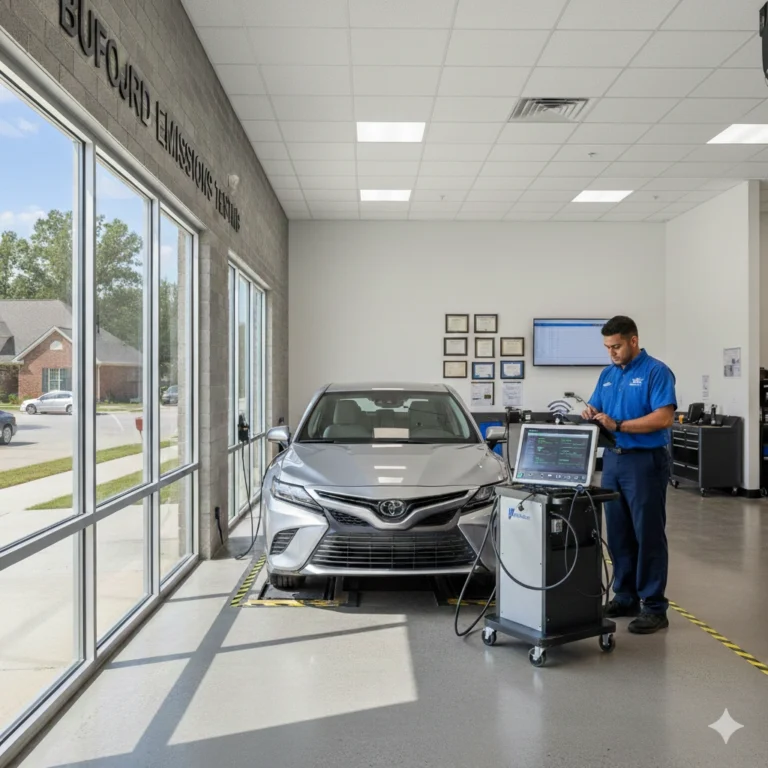
Emission First LLC at 3833 Buford Dr, Buford, GA tests trucks and SUVs of all sizes every day — F-150s, Silverados, Rams, Tacomas, Tundras, Expeditions, Suburbans, 4Runners, and everything in between. If your vehicle is under 8,500 lbs GVWR and within the eligible model year range, the testing process is the same as any other vehicle.
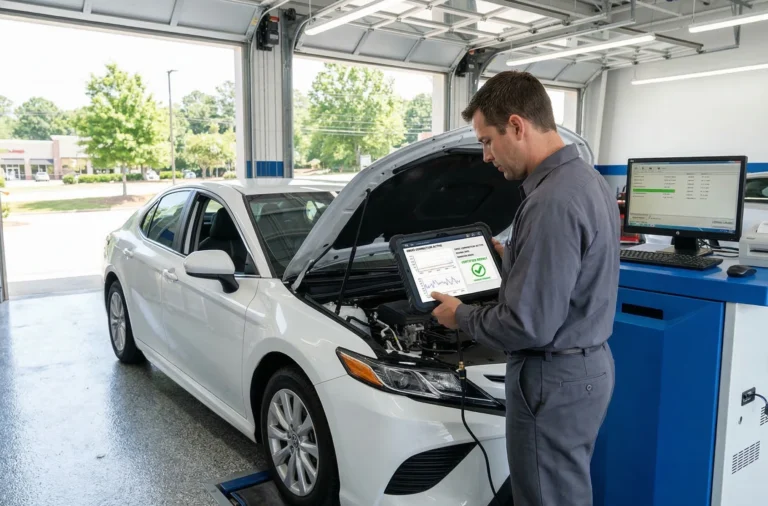
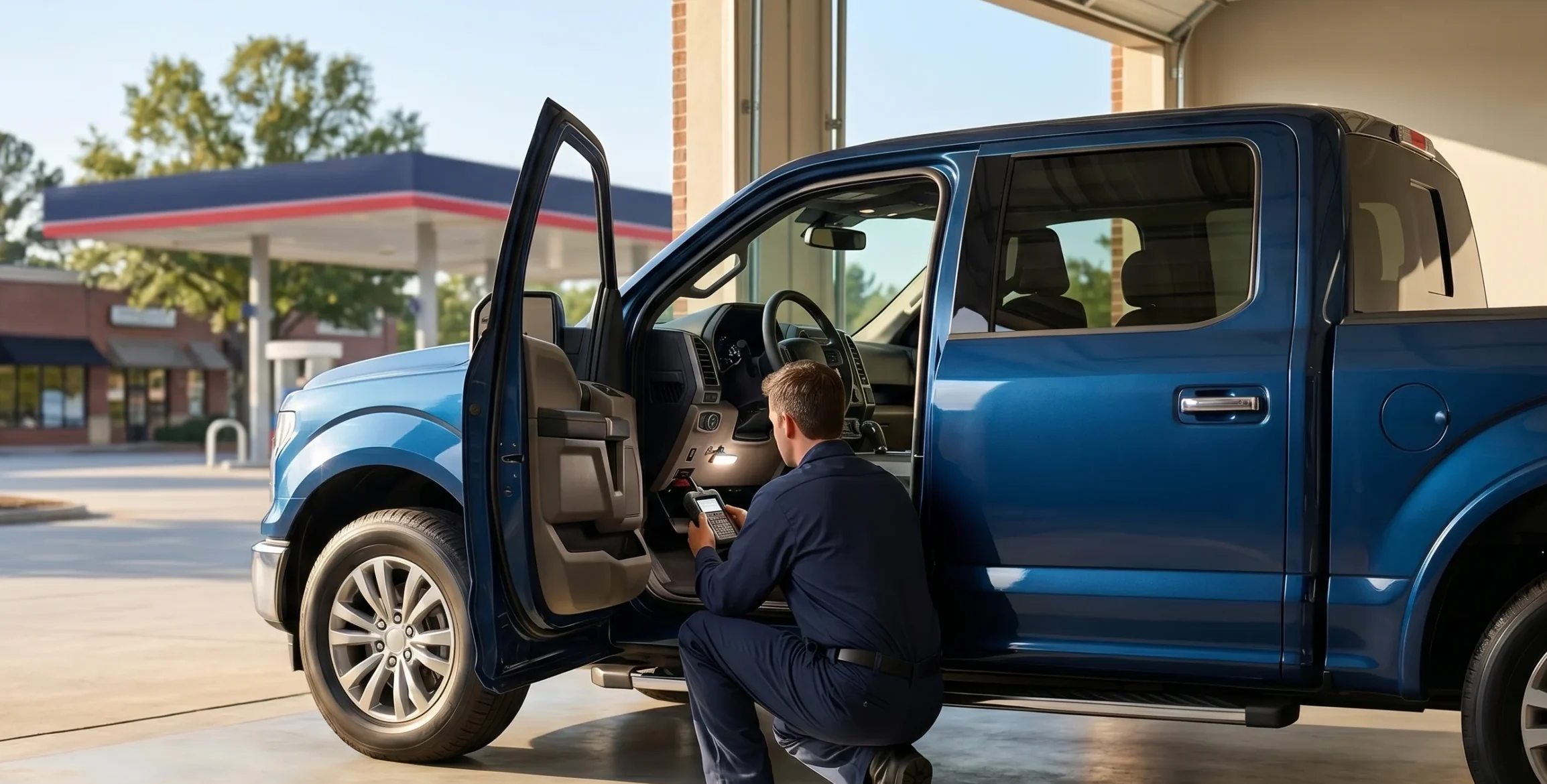
Walk in Monday through Saturday. No appointment needed. Pull your truck straight into our testing bay, and a certified technician will connect the GCAF-approved OBD-II scanner. The scan runs 5 to 10 minutes. Results are immediate. Your certificate goes into the Georgia DOR database right away — and you can complete your registration renewal online the same day you pass.
Cash $14.99 · Card $15.99 · No Appointment · Walk-Ins Welcome Mon–Sat
If your truck has failed before or you want to understand the retest process, read our complete guide: My Car Failed the Emissions Test in Georgia — Here Is Exactly What to Do Next.
And when you are ready to renew your tags after passing, the full registration renewal process is explained here: How to Renew Your Car Registration in Gwinnett County, GA — Complete 2026 Guide.
Frequently Asked Questions — Trucks and SUVs, Georgia Emissions Testing
Does my Ford F-150 need an emissions test in Georgia? Yes, if it is a model year 2002 through 2023 and registered in Gwinnett County. The F-150’s GVWR is typically well under 8,500 lbs. Walk in any day, Monday through Saturday, at Emission First LLC in Buford — $14.99 cash, no appointment needed.
Does my Ford F-250 or F-350 need an emissions test in Georgia? No. The F-250 and F-350 Super Duty have GVWRs that start around 10,000 lbs, which puts them above the 8,500 lb exemption threshold. They do not require Georgia emissions testing.
Does my Chevy Silverado 1500 need an emissions test? Yes, if it is a 2002 through 2023 model year registered in Gwinnett County. The 1500 is a light-duty truck under 8,500 lbs GVWR.
Does my Chevy Silverado 2500HD need an emissions test? No. The 2500HD exceeds 8,500 lbs GVWR and is exempt from Georgia emissions testing.
Does my Ram 1500 need an emissions test? Yes, if it is 2002 through 2023 and registered in Gwinnett County. The Ram 1500 is under 8,500 lbs GVWR.
Does my Ram 2500 need an emissions test? No. The Ram 2500 exceeds the 8,500 lb threshold and is exempt.
Does my diesel truck need an emissions test in Georgia? No. Diesel vehicles are exempt from Georgia emissions testing regardless of model year. Emissions-testing. This applies to diesel F-250s, diesel Ram 2500s, diesel Silverado 2500HDs, and any other diesel-powered vehicle.
Does my Toyota Tacoma need an emissions test? Yes, if it is 2002 through 2023 and registered in Gwinnett County. The Tacoma is well under 8,500 lbs GVWR.
Does my Chevy Suburban or GMC Yukon XL need an emissions test? It depends on your specific configuration. Some Suburban and Yukon XL configurations are at or under 8,500 lbs GVWR and require testing. Others exceed it and are exempt. Check the GVWR sticker on your driver’s door jamb for the definitive answer on your specific vehicle.
How much does a truck emissions test cost in Buford, GA? At Emission First LLC, the emissions test for any vehicle — including trucks and SUVs — is $14.99 cash or $15.99 by card. No hidden fees. Walk in Monday through Saturday at 3833 Buford Dr, Buford, GA.
Where is Emission First LLC located? 3833 Buford Dr, Buford, GA 30519 — next to the Chevron station, behind Cash Bucks Title Pawn, beside Asia Grill Buffet on Buford Drive. Do not follow GPS to the Walmart lot — look for the Chevron canopy.
Bring Your Truck In This Week
F-150, Silverado 1500, Ram 1500, Tacoma, Tundra, 4Runner, Expedition, Suburban — if it is under 8,500 lbs GVWR and model year 2002 through 2023, it needs its annual Georgia emissions test before you can renew your Gwinnett County registration.
Walk in any time Monday through Saturday. No appointment. Pull your truck straight in, and we will have you done and out in under 15 minutes.
📍 Emission First LLC 3833 Buford Dr, Buford, GA 30519 Next to Chevron · Behind Cash Bucks Title Pawn · Beside Asia Grill Buffet
📞 +1 (470) 273-9500 · 💬 wa.link/udbyhf
Cash $14.99 · Card $15.99 · No Appointment · Walk-Ins Welcome Mon–Sat