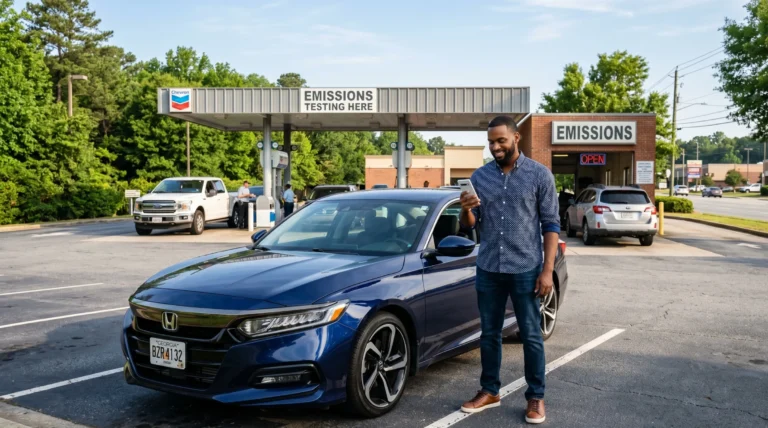
Check Engine Light On? Here’s What It Really Means for Your Georgia Emissions Test
You’re sitting at a red light on Buford Drive. Your registration renewal is coming up in two weeks. You glance at your dashboard, and there it is: that small amber glow every driver dreads.
The check engine light.
Your first thought is probably about registration. Can you still get your emissions test done? Will you fail automatically? Will the light go away on its own? Can you disconnect the battery to reset it? What does it mean for your situation?
These are the exact questions drivers ask at Emission First LLC every week. In most cases, they arrive already knowing the answer is probably not good but hoping we will tell them something different.
We are going to be straight with you, just as we are with every customer who drives in. Here is exactly what a check engine light means for your Georgia emissions test, why it causes an automatic failure, what the most common codes are, how much most fixes cost, and the fastest path from that amber glow to a passing certificate in Gwinnett County.
The Short Answer: Yes, a Check Engine Light Means an Automatic Failure
Make sure the vehicle does not have its check engine light on. If it does, it will not pass the Georgia emissions test. Emission First
There is no flexibility here, no workaround, and no exception. If your check engine light, also called the Malfunction Indicator Lamp (MIL), is illuminated when you pull into any Georgia Clean Air Force (GCAF) certified emissions testing station in Gwinnett County, your vehicle will fail the test before the scan even finishes evaluating anything else.
This is not a quirk of Georgia’s system. It is a core part of how the On-Board Diagnostics II (OBD-II) testing protocol works. The check engine light is your vehicle’s way of telling you and the testing equipment that the onboard computer has detected a problem serious enough to flag. In Georgia’s emissions testing framework, an illuminated MIL (Malfunction Indicator Lamp) is treated as evidence that at least one emissions-related system is not performing within acceptable limits and that alone is sufficient cause for failure.
It does not matter how minor the underlying issue actually is. It does not matter whether the vehicle runs perfectly fine otherwise. It does not matter whether the light just came on this morning or has been on for six months. An active check engine light is an automatic failure. Every time.
Why the Check Engine Light Causes an Automatic Failure: The Technical Reason
Understanding why this rule exists makes it easier to accept and also helps you understand exactly what needs to happen to fix it.
Your vehicle’s onboard diagnostic computer, called the OBD-II system, continuously monitors dozens of sensors and systems related to engine performance and emissions. When any of those sensors reports a reading outside the acceptable range, the computer stores a Diagnostic Trouble Code (DTC) in its memory and illuminates the check engine light to alert you.
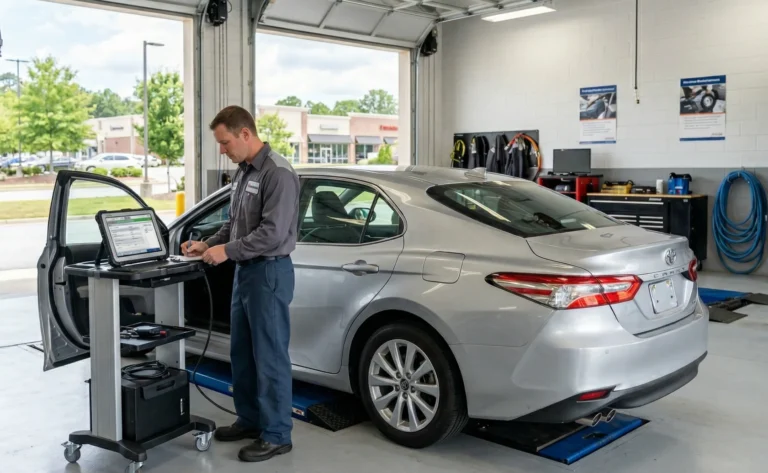
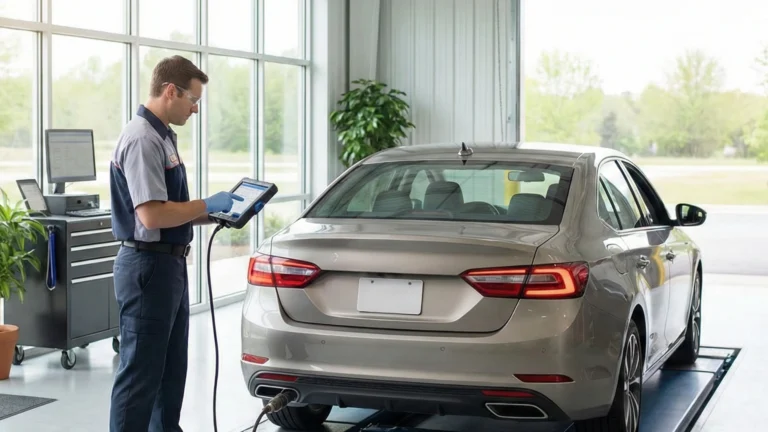
The OBD-II scanner that Georgia’s certified testing stations use, including Emission First LLC, reads that stored code directly from your vehicle’s computer. When an active code is present and the MIL is illuminated, the scanner immediately identifies this as a failure condition. A lit check engine light results in automatic failure for Georgia emissions testing.
The logic is straightforward: if your vehicle’s own computer has flagged something as wrong with an emissions-related system, the state cannot certify that vehicle as emissions-compliant. The certification would be meaningless if it could be issued despite the vehicle’s computer explicitly signaling a problem.
This is also why some people think they can outsmart the system by clearing the codes right before the test. We will address why that strategy always backfires in a moment.
Active vs. Pending Codes: What Is the Difference?
There are two types of diagnostic trouble codes that matter for your emissions test, and understanding the difference helps you know exactly what you are dealing with.
Active codes are the ones that have triggered the check engine light to illuminate on your dashboard. These are confirmed faults your vehicle’s computer has detected, confirmed them across multiple monitoring cycles, and lit the light to tell you. An active code means the check engine light is on. This is an automatic failure.
Pending codes are codes that have been detected once or twice but have not yet been confirmed across enough monitoring cycles to trigger the check engine light. Your check engine light may be completely off, but the scanner can still detect that a fault is developing. Pending codes do not automatically fail your emissions test, but they are a warning that a fault is developing and the check engine light could come on soon.
At Emission First LLC, when we scan a vehicle, we see both active and pending codes. If we find pending codes on a vehicle that otherwise passes, we always mention them to the customer as a heads-up, not because they affect the test result today, but because they may cause a failure and a check engine light before the next renewal if the underlying issue is not addressed.
The Most Common Check Engine Light Codes That Cause Failures in Buford
After testing thousands of vehicles in Gwinnett County, the same diagnostic trouble codes appear over and over as the causes of emissions failures at Emission First LLC. Here is what they mean and roughly what they cost to fix.
P0420 / P0430 Catalyst System Efficiency Below Threshold
This is the most common code we see leading to failures, particularly on vehicles with over 100,000 miles. It means the catalytic converter is not performing at the efficiency level the onboard computer expects. The catalytic converter converts harmful exhaust gases into less toxic compounds when it degrades, and both emissions output and OBD readings move out of the acceptable range.
Repair cost: A catalytic converter replacement typically runs $400 to $1,200 or more, depending on the vehicle, converter type, and labor. If costs are high, document every repair receipt carefully; they count toward the $1,176 repair waiver threshold if you end up needing one. For the full failure and waiver guide, read: My Car Failed the Emissions Test in Georgia Here Is Exactly What to Do Next.
P0171 / P0174 System Too Lean (Bank 1 / Bank 2)
These codes indicate the engine is running with too much air and not enough fuel, a lean condition. Common causes include a vacuum leak, a dirty or failing mass airflow sensor, a weak fuel pump, or clogged fuel injectors. These codes light the check engine light and cause a test failure.
Repair cost: Ranges from $50 to $500, depending on the cause. A vacuum leak from a cracked hose is on the low end. Fuel pump replacement is on the higher end.
P0442 / P0455 EVAP System Leak (Small / Large)
The evaporative emission control system prevents fuel vapors from escaping from the fuel system into the atmosphere. Leaks in this system, ranging from a loose gas cap to a cracked charcoal canister, trigger these codes and the check engine light. A common fix is to check if the gas cap is on tight. If it is not, tighten it and drive around to see if the light goes off. Emission First
This is genuinely worth trying before you call a mechanic. Remove your gas cap, inspect the rubber seal for cracks or damage, reinstall it firmly until you hear it click, and drive normally for a day or two. If the gas cap was the cause, the light may go off on its own after a few drive cycles. If the light stays on after tightening the cap, the leak is elsewhere in the EVAP system.
Repair cost: Gas cap replacement is $10 to $20. EVAP component repairs beyond the gas cap range from $100 to $600.
P0300 / P0301–P0308 Random or Cylinder-Specific Misfires
Misfires indicate that one or more cylinders are not firing correctly. Common causes include worn spark plugs, a faulty ignition coil, low compression, or a failing fuel injector. Misfires increase emissions significantly and always trigger the check engine light.
Repair cost: Spark plug replacement is $100 to $300. Ignition coil replacement is $150 to $400 per coil. More complex misfires can be higher.
P0135 / P0141 / P0155 / P0161 Oxygen Sensor Heater Circuit Malfunction
Oxygen sensors monitor the oxygen content of exhaust gases and feed real-time data to the engine computer for fuel mixture adjustment. When an oxygen sensor heater circuit fails, the sensor does not reach operating temperature quickly enough, degrading its performance and triggering the check engine light.
Repair cost: Oxygen sensor replacement typically costs $150 to $350 per sensor installed, depending on the vehicle and which sensor requires replacement.
P0401 EGR Flow Insufficient
The exhaust gas recirculation system reduces nitrogen oxide emissions by recirculating a portion of exhaust gas back into the engine. When the EGR valve becomes clogged or fails, the code triggers the check engine light and causes an emissions failure.
Repair cost: EGR cleaning or replacement typically runs $150 to $400, depending on the severity.
Why Clearing the Codes Before Your Test Never Works
Every week at Emission First LLC, we see drivers who try to outsmart the system by clearing their OBD codes either by disconnecting the battery, using a scan tool to erase the codes, or having an auto parts store clear them right before coming in for their test.
We understand the logic. Clear the codes, the check engine light goes off, come in and pass before the light comes back on. It seems like it should work.
It never works. Here is why.
When you clear diagnostic codes by any method, you do not just erase the check engine light. You reset your vehicle’s entire OBD system, including all the readiness monitors. Readiness monitors are the self-check cycles your vehicle’s computer runs on each emissions-related system. After any code clearing or battery disconnect, all applicable monitors reset to an incomplete or “not ready” status.
Anytime you flash a tune, clear codes, or disconnect the battery, the monitors reset to “not ready.” You’ll need to complete drive cycles again before testing Georgia’s emissions test, which evaluates both the check engine light status and the readiness monitor status. Incomplete monitors are also a failure condition.
So if you clear the codes and drive straight to the emissions station, you will fail not because of the check engine light, but because your readiness monitors have not had time to complete. Your vehicle needs to be driven through multiple normal operating cycles, typically 50 to 100 miles of mixed city and highway driving, before the monitors return to a complete status.
And here is the other problem: clearing codes does not fix anything. Whatever caused the code in the first place is still there. After enough drive cycles for the monitors to complete, the underlying fault will trigger the code again, and the check engine light will come back on, often before the monitors have all finished cycling.
The only path that actually works is addressing the underlying issue that caused the code, then driving the vehicle long enough for all monitors to complete, and then coming in for the test.
What to Do Right Now If Your Check Engine Light Is On
Here is the practical step-by-step if your check engine light came on and your emissions test is coming up.
Step 1: Do not come to Emission First LLC yet.
We will tell you honestly, the moment you pull in, your vehicle will fail. Save yourself the test fee and follow the steps below first.
Step 2: Get the code read for free.
Take your vehicle to any auto parts store, such as AutoZone, O’Reilly Auto Parts, Advance Auto Parts, or NAPA, and ask them to scan your OBD codes. This service is free at most stores. They will give you the specific diagnostic trouble code, such as P0420 or P0171, and a brief description of what it means.
Write down the code number exactly. This is the information your mechanic needs.
Step 3: Check your gas cap first.
Before you call a mechanic, try the simplest possible fix. Remove your gas cap, inspect the rubber seal, reinstall it firmly until you hear it click, and drive normally for two to three days. If the code was P0440, P0442, or P0455 related to the EVAP system, a loose gas cap is often the sole cause, and the light may go off on its own after the computer confirms the fix across a few drive cycles.
If the light stays on after two to three days of normal driving, the issue is more than a gas cap.
Step 4: Take your vehicle to a licensed mechanic.
Bring the specific code number. Ask for a diagnostic analysis, which tells the mechanic exactly which component failed and why, which saves both time and money compared to guessing. Keep the itemized receipt for the diagnostic analysis; it counts toward the repair waiver threshold if costs become significant.
Step 5: Authorize the repair.
Once the mechanic identifies the cause, get the repair done. Make sure they fill out any repair documentation properly, especially if you are close to needing a retest after a previous failure.
Step 6: Drive 50 to 100 miles before coming in for your test.
After the repair is complete and the code has been cleared by the mechanic, drive your vehicle normally for 50 to 100 miles, a mix of highway and city driving. This allows all the OBD readiness monitors to complete their cycles and return to a ready status. Do not rush this step.
Step 7: Walk into Emission First LLC.
Once the check engine light has been off for a few days and you have driven 50 to 100 miles, come in any time Monday through Saturday. No appointment. Pull straight in. The test runs in 5 to 10 minutes, and if everything is clear, your certificate is issued immediately.
For a complete pre-test checklist beyond just the check engine light, read our full guide: How to Know If Your Car Will Pass the Emissions Test Before You Go.
What If the Check Engine Light Keeps Coming Back?
This is where things get more complicated and more expensive. Some vehicles have underlying issues that are either difficult to diagnose or expensive to repair, or both. If the check engine light keeps returning after repairs, a few scenarios are possible.
The repair was incomplete. A related but not identical fault is present. The original repair fixed one component, but a second component in the same system is also failing. This is common with oxygen sensors — replacing one sensor can reveal that another is also marginal.
The repair was done incorrectly. This is why using a licensed, ASE-certified repair facility matters. Poorly done repairs or low-quality replacement parts can cause recurring codes. If the same code keeps returning after a repair, return to your mechanic with the documented history.
The vehicle has a deeper underlying issue. Some vehicles, particularly high-mileage ones, have systemic issues where one code leads to another in a cascading pattern. If repair costs are escalating toward the $1,176 repair waiver threshold and the vehicle still cannot pass, document every single receipt meticulously and apply for the Georgia repair waiver.
The check engine light is coming on intermittently. An intermittent fault, one that triggers the light sometimes but not consistently, can make diagnosis harder. If the light is off on the day you come in for your test, an intermittent code that has not been active recently will not show as an active failure. However, pending codes for that same fault may still be visible on the scanner and could indicate the light will return.
How Long Does It Take to Fix a Check Engine Light Issue?
This depends entirely on the underlying cause, but here is a realistic general timeline for the most common scenarios.
Gas cap replacement: Same day. Buy the cap, install it, and drive for two to three days for the monitors to clear. Total timeline: three to five days.
Oxygen sensor replacement: Typically, same-day or next-day repair at most shops. After repair, drive 50 to 100 miles. Total timeline: four to seven days.
EVAP system component (beyond gas cap): Diagnosis one to two days, repair one to two days, monitor reset driving three to four days. Total timeline: one to two weeks.
Catalytic converter replacement: Parts availability varies. In-stock replacements can be done same-day or next-day. After repair, drive 50 to 100 miles. Total timeline: one to two weeks.
Misfire diagnosis and repair: Varies widely depending on the cause. Spark plugs and coils are quick. Fuel injectors or compression issues take longer. Total timeline: one to three weeks.
This is exactly why Georgia’s Clean Air Force recommends testing four to six weeks before your renewal deadline. It’s best to get your vehicle inspected four to six weeks before the registration renewal date, in the event repairs need to be made. emissionfirst A check engine light discovered six weeks before your deadline is a manageable situation. The same light discovered three days before your deadline is a genuine crisis.
Can the Check Engine Light Go Off on Its Own?
Sometimes, but not in ways you should count on before an emissions test.
If the cause of the check engine light was a temporary condition, a brief sensor glitch, a momentary fuel system anomaly, or a loose gas cap that you tightened, the light may go off on its own after the vehicle’s computer confirms the fault is no longer present across several drive cycles.
The problem is that you cannot know whether your specific check engine light is the result of a temporary condition or an ongoing fault without reading the code. A light that appears to have gone off on its own may simply be in a temporary “healing” state between triggered events, and it can come back on at any time, including mid-drive on the way to the emissions station.
Never count on a check engine light going off on its own before an important deadline. Get the code read, understand what caused it, and address it properly.
The Bottom Line for Gwinnett County Drivers
A check engine light before your Georgia emissions test is a problem; it is a fixable one in almost every case. The key is acting immediately rather than hoping it goes away on its own or trying to clear it temporarily.
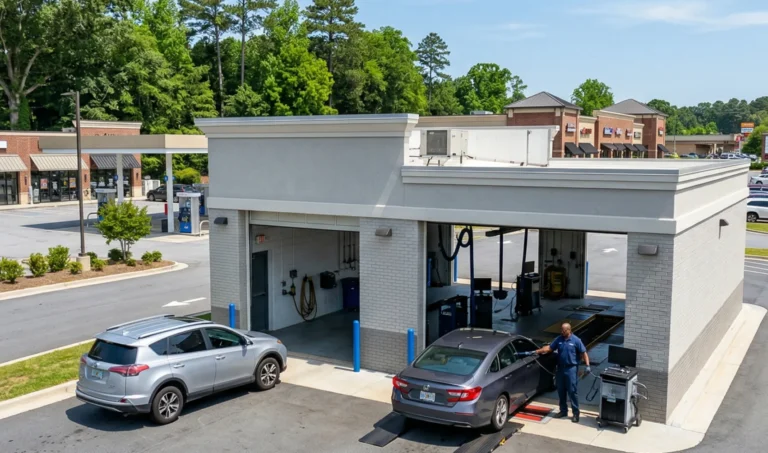
Get the code read for free at any auto parts store. Try the gas cap fix if the code is EVAP-related. If the issue is more significant, take it to a licensed mechanic, get the repair done, drive 50 to 100 miles, and then walk into Emission First LLC at 3833 Buford Dr in Buford, GA.
We test Monday through Saturday with no appointment needed. The scan takes 5 to 10 minutes. If you pass and with the check engine light off and monitors complete, the vast majority of well-maintained vehicles, once your certificate is in the Georgia DOR database, the moment your test finishes, you can renew your registration online the same day.
For the full picture of what Gwinnett County registration renewal looks like once your emissions test is passed, read: How to Renew Your Car Registration in Gwinnett County, GA Complete 2026 Guide.
And if your vehicle fails for any reason, check engine light or otherwise, read: My Car Failed the Emissions Test in Georgia Here Is Exactly What to Do Next.
📍 Emission First LLC 3833 Buford Dr, Buford, GA 30519 Next to Chevron · Behind Cash Bucks Title Pawn · Beside Asia Grill Buffet
📞 +1 (470) 273-9500 · 💬 wa.link/udbyhf
Cash $14.99 · Card $15.99 · No Appointment · Walk-Ins Welcome Mon–Sat